Gokyo Trek via Everest Base CampGokyo Trek via Everest Base Camp

Everest Base Camp with Gokyo Valley Trek

ratingbased on 4 reviews
  • Duration18 Days
  • Difficulty Level Strenuous
  • Activity Trekking/Hiking
  • Max. Altitude 5550 meters/ 18209 feet.
  • Starts Lukla
  • Ends Lukla
  • Group Size 1-12
  • Best Season March to May & September to November
Group Discount Prices
  
1 paxUS$1790
2 - 3 paxUS$1490
4 - 7 paxUS$1445
8 - 12 paxUS$1390
Everest Base Camp with Gokyo Valley Trek Highlights
  •  
  • Scenic and thrilling flight from Kathmandu to Lukla Airport over the Himalayan ridges, Dudh Koshi river, and ridgelines.
  • Exploration of the multi‑faceted wilderness of Sagarmatha National Park, a UNESCO World Heritage site filled with rhododendron forests, alpine meadows, glacier‑carved valleys, and high‑altitude ridges.
  • Varied trail conditions with lush forests, suspension bridges, steep alpine slopes, glacier moraines, and Sherpa villages like Phakding, Dole, Machhermo, and Lunde.
  • Chance to visit the Sherpa capital of Namche Bazaar and the historic Tengboche Monastery.
  • Chance to meet the legendary Sherpas, renowned mountain guides of the region. 
  • Rich cultural and village experiences, including Sherpa settlements, yak caravans, Saturday markets in Namche, and monasteries in Khumjung and Kunde.
  • Arrive at the historic Everest Base Camp itself (5,364 meters).
  • Direct views of iconic Mount Everest and its historic base camp, along with neighbouring giants like Lhotse and the expansive Khumbu Glacier.
  • Opportunity to take high‑altitude summits and passes such as Kala Pattar, Cho La Pass, and Gokyo Ri, each offering panoramic Himalayan vistas and unforgettable photos.
  • Mesmerizing glacier‑fed Gokyo Lakes, which are a high‑altitude lake system of turquoise waters.
  • Experience local festivals such as Mani Rimdu, Dumji, and Lhosar, and experience their peaceful Buddhist faith.
  • Possibility of spotting Himalayan wildlife like musk deer, Himalayan tahr, or alpine birds such as the Impeyan pheasant.
  •  

Everest Base Camp With Gokyo Valley Trek Overview

The Everest Base Camp With Gokyo Valley Trek is one of the most iconic high-altitude journeys in the Nepal Himalayas, combining two of the region’s most breathtaking adventures in a single 18-day trek. This route takes you from the foot of the world’s highest mountain to the magical turquoise waters of Gokyo Lakes, traversing the rugged wilderness of Sagarmatha National Park, a UNESCO World Heritage site in the Khumbu region

You will start this journey with a scenic flight from Kathmandu to Lukla (2,840 meters). Following it, you will then trek through vibrant rhododendron forests, alpine meadows, and high-altitude zones, offering chances to spot musk deer, Himalayan tahr, and occasionally even the elusive snow leopard.

This incredible trek winds through some of the most spectacular high-altitude terrain in Nepal. From Lukla, you will pass through Phakding, a small Sherpa village nestled along the Dudh Koshi River, where the path is gentle and well-marked.

Next, the trek ascends to Namche Bazaar, the bustling Sherpa capital. The trail from Phakding to Namche crosses suspension bridges over roaring rivers and winds through dense rhododendron forests. While in Namche, you will also acclimatize by hiking to the Everest View Hotel, visiting the Sherpa Cultural Museum, or exploring Khumjung Monastery and its famous Yeti scalp.

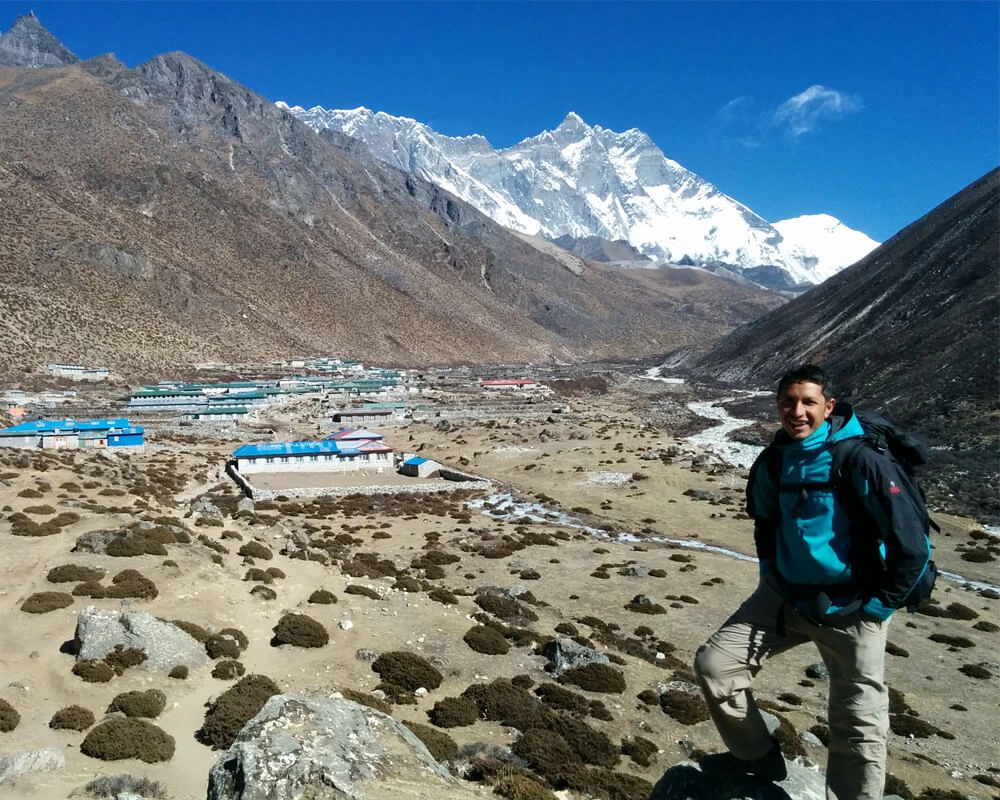
From Namche, the route climbs to Tengboche, home to the largest monastery in the Khumbu region. You will follow trails lined with prayer flags, cross smaller suspension bridges, and traverse switchbacks through pine and rhododendron forests, with panoramic views of Ama Dablam, Thamserku, and Kangtega. The trail continues to Dingboche, which is another spot for high-altitude acclimatization. While here, you will get to enjoy uninterrupted Himalayan vistas and can hike nearby ridges like Nangkartshang Ri.

As the journey progresses, the trail passes Lobuche before reaching Gorak Shep, the launching point for the Everest Base Camp trek. From here, the trek to Everest Base Camp itself is one of the ultimate highlights. Soon, you will trek across Cho La Pass (5,420 meters), which is a moderately technical high-altitude pass offering breathtaking panoramas of Ama Dablam, Baruntse, and Cholatse

Moving forward, you will then descend to Dragnag and then on to Gokyo Lakes. Then, you will take a climb to Gokyo Ri (5,360 meters) to enjoy 360-degree Himalayan vistas, including Everest, Lhotse, Makalu, and Cho Oyu.

All in all, the return journey retraces steps through Dole and Namche Bazaar, gradually descending through alpine forests, suspension bridges, and Sherpa villages, before reaching Lukla to complete the trek.

Well, the Everest Base Camp trek via Gokyo Valley is perfect for adventurous trekkers seeking a high-altitude challenge while enjoying a less crowded alternative to the classic Everest Base Camp route. Whether you are chasing 360-degree mountain vistas, cultural immersion, or the thrill of standing near Everest Base Camp and Gokyo Ri, this journey is your ultimate Nepal trekking adventure.

If you are looking for other ways to explore the Everest region, you can opt for the classic EBC trek for the iconic route and vibrant Sherpa culture, or focus purely on the breathtaking Gokyo Valley with its stunning lakes and panoramic peaks. 

What Makes The Everest Base Camp Via Gokyo Trek Unique?

Combined EBC and Gokyo Journey in One Adventure

If you are looking to maximize your Everest region adventure, the Combined Everest Base Camp and Gokyo Lakes Trek is the ultimate choice. This trek brilliantly fuses two of Nepal’s most iconic high-altitude experiences into a single, unforgettable journey. You will get to stand at the historic Everest Base Camp and also explore the pristine Gokyo Lakes system.

The trek takes you to multiple high viewpoints, including the panoramic Gokyo Ri and Kala Patthar, each offering spectacular vistas of Mount Everest, Lhotse, Nuptse, Makalu, and Cho Oyu. Similarly, you will also cross the challenging Cho La Pass, navigating moraine valleys and glacier-fed rivers, while also witnessing the grandeur of Ngozumpa Glacier, Nepal’s largest glacier.

Spanning approximately 17 to 18 days, this journey covers a variety of terrain, from lush rhododendron forests and alpine meadows to high-altitude moraine valleys and icy glacier paths. Altogether, this trek blends thrill, natural beauty, serene landscapes, and cultural immersion.

This combined itinerary is perfect for trekkers, photographers, and culture enthusiasts who want to experience the best of the Everest region without splitting their adventure into separate trips.

Thrilling Flight to Lukla

One of the most exhilarating parts of the Everest Base Camp with Gokyo Valley Trek is the thrilling flight to Lukla. Taking off from Kathmandu, or from Ramechhap during the peak season, the flight lasts about 30 to 40 minutes, and gives you an aerial introduction to the Nepal Himalayas. You will generally depart for this flight at an early morning, usually between 6:00 and 8:00 AM, for the clearest skies and smoothest flying conditions.

The Lukla runway is famous for its short, steep strip perched amid dramatic terrain, making the landing thrilling. From your window seat, the scenery is breathtaking, with valleys unfolding below, deep green forests gradually giving way to alpine meadows and rugged high-altitude terrain, while peaks like Mount Everest, Lhotse, Ama Dablam, and Nuptse appear in the distance.

However, you must also be ready for the occasional delay or reroute for your flight, as the weather in the high Himalayas can change in an instant.

Panoramic Himalayan Views from Multiple High Points

One of the most thrilling aspects of the Everest Base Camp Trek via Gokyo Valley is the breathtaking panoramic Himalayan views from multiple high-altitude vantage points. Each stop along the route offers a unique perspective of the world’s tallest peaks, giving you unforgettable photo opportunities.

Starting near Namche Bazaar at the Everest View Hotel, you will catch your first glimpses of Mount Everest (8,848 meters), Lhotse (8,516 meters), and Ama Dablam (6,812 meters). The views here are majestic but distant, perfect for acclimatization and capturing those first epic sunrise shots.

For a closer, lesser-crowded perspective, the Nangkartshang Ri viewpoint delivers unobstructed panoramas of Ama Dablam, Thamserku (6,623 meters), and Kangtega (6,782 meters). It’s ideal if you are seeking a quieter spot to admire the Khumbu Valley.

At Everest Base Camp, the thrill reaches its peak. Standing beside the Khumbu Glacier, with Nuptse (7,861 meters) and Lhotse looming nearby, you will truly feel the gravity of being at the foot of the world’s highest mountain.

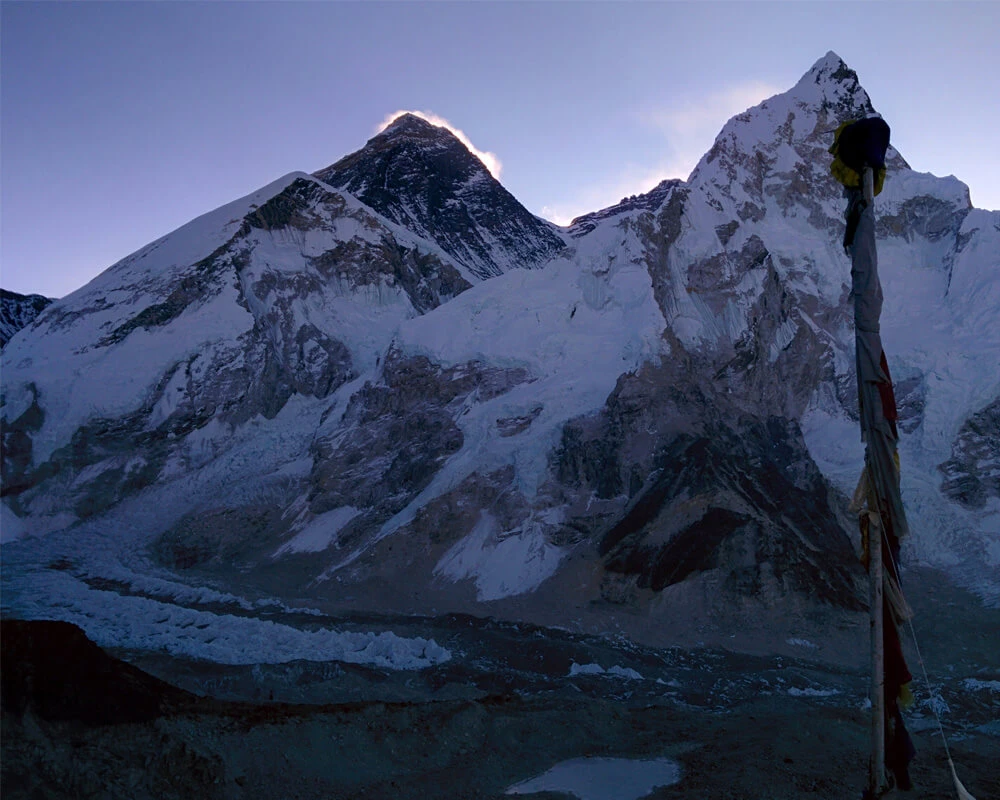
Moving on, Kala Patthar is widely regarded as the best viewpoint for Everest. From 5,545 meters, you get an unparalleled panorama of Everest, Lhotse, Nuptse, Changtse, and the surrounding glacial valleys. Sunrise or early morning hikes here cast a golden glow on the peaks, making it a paradise for photography enthusiasts.

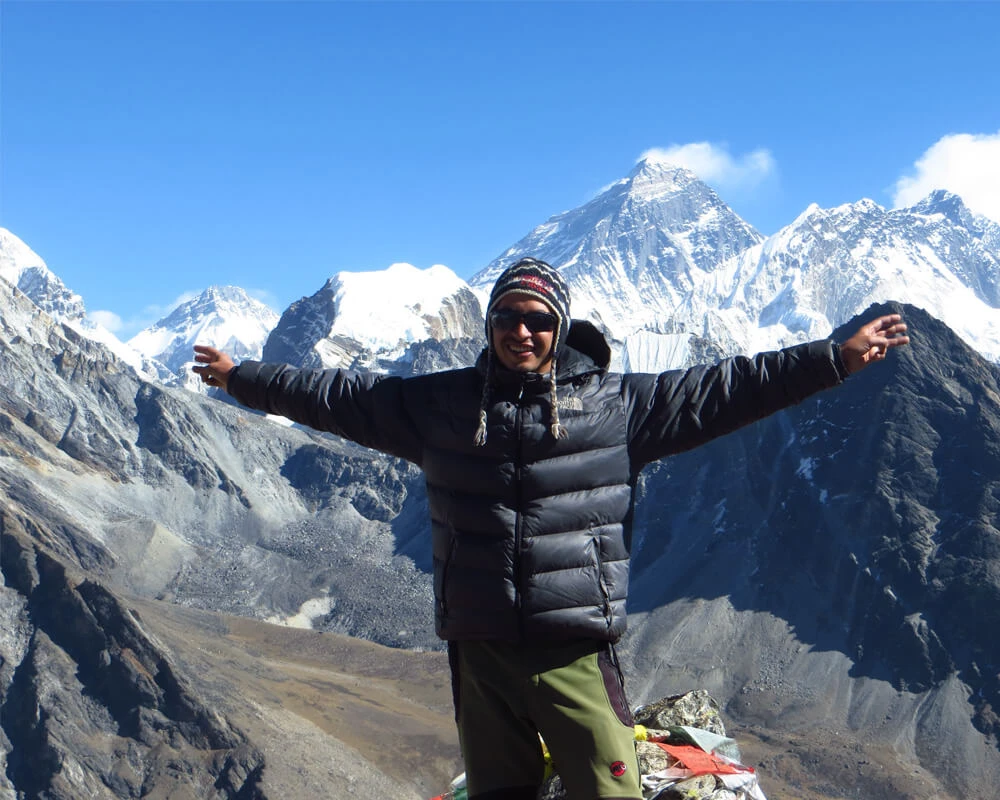
Finally, Gokyo Ri provides a 360° panorama of the Gokyo Lakes and the Everest region. From this remote vantage point, you can admire Everest, Cho Oyu (8,201 meters), Makalu (8,463 meters), and Lhotse in one sweeping vista. Compared to Kala Patthar, it’s more peaceful, allowing you to soak in the high-altitude serenity.

Across all these points, you will experience different perspectives of Everest and surrounding peaks, from golden sunrises to dramatic sunsets.

High-Altitude Gokyo Lakes

The Gokyo Lakes are arguably one of the most breathtaking and sacred natural wonders in Nepal’s Everest region. Nestled high in the Khumbu region inside Sagarmatha National Park, they form one of the world’s highest freshwater lake systems, renowned for their surreal turquoise waters and spiritual significance.

The system comprises six main lakes: Thonak Cho, Gokyo Cho, Gyazumpa Cho, Tanjung Cho, Ngozumpa Cho, and Longpongo. Among these, the Dudh Pokhari, next to Gokyo village, is the most photogenic and frequently visited. It is surrounded by snow-capped peaks, and beneath the iconic Gokyo Ri viewpoint, this lake offers a perfect combination of photography, meditation, and high-altitude adventure.

Fed by the Ngozumpa Glacier, Nepal’s largest glacier, the lakes shimmer with changing hues, deep blues, aquamarine, and emerald, depending on the sunlight and time of day. Beyond their visual beauty, these lakes hold deep spiritual significance for both Hindus and Buddhists. Locals believe they are the abode of Nag Devata (the serpent deity), and during Janai Purnima in August, hundreds of pilgrims perform rituals and take holy baths at the small temple dedicated to Lord Vishnu and Shiva beside the lake.

While here, you will witness surrounding peaks including Cho Oyu and Gyachung Kang (7,952 meters), and the dramatic expanse of Ngozumpa Glacier. From the Gokyo Ri viewpoint above, you will be rewarded with 360° panoramic views of Everest, Lhotse, Makalu, Cho Oyu, and the entire Gokyo Valley.

Immersive Sherpa Culture and Traditions

One of the most enriching aspects of the Everest Base Camp with Gokyo Valley Trek is experiencing the vibrant Sherpa culture firsthand. The Sherpas, an ethnic group of the Khumbu and Everest region, are culturally tied to Tibetan heritage, and their daily lives revolve around high-altitude agriculture, yak herding, local trade, and guiding trekkers and climbers along the Himalayan trails.

Their Tibetan Buddhist traditions are woven into everyday life, from prayer flags fluttering above villages to the serene atmosphere of monasteries. Trekking through Sherpa villages like Namche Bazaar, Tengboche, and Khumjung, you will hear the Tibeto-Burman language, see locals preparing tsampa and yak butter tea (po cha), and witness homes that are beautifully adapted to life at high altitudes.

Timing your trek right allows you to experience major Sherpa festivals, such as Mani Rimdu (October or November), Dumje (July), and Gyalpo Lhosar (February or March). These celebrations feature masked dances, communal feasts, and prayers.

Diverse Landscapes, Flora, and Fauna

Starting from lush rhododendron and pine forests at lower altitudes (around 2,600 to 3,500 meters), the trail gradually transitions into alpine meadows, moraine valleys, glaciers, and bare stone slopes as you ascend above 4,000 meters. Each stretch of the trail offers a distinct visual and ecological experience, from the gentle greenery near Phakding and Namche Bazaar to the rugged terrain near Lobuche, Gorak Shep, and the high Gokyo Valley lakes.

At lower altitudes, you will notice pine, hemlock, fir, birch, juniper, and vibrant rhododendron trees, while mid-altitude zones feature juniper shrubs, alpine grasses, and hardy rhododendron bushes. As you climb higher, vegetation becomes sparse, with only lichens and mosses clinging to rocky surfaces in the harsh high-altitude zones.

Wildlife encounters are equally fascinating. You may encounter musk deer, Himalayan tahr, snow leopards (rare), and even red pandas in parts of Sagarmatha National Park. You may also get glimpses of the Himalayan pheasant (Impeyan pheasant), snow cock, blood pheasant, and alpine choughs.

18-Day Everest Base Camp With Gokyo Trek Cost For 2026/2027

If you are planning your Everest Base Camp with Gokyo Valley Trek for 2026/2027, the standard 18-day trek package is priced at USD 1,790 per person. This package price includes accommodation in cozy tea houses, three meals a day, a licensed professional guide, bus transportation, and all the required permits to explore the Everest region and Gokyo Valley hassle-free.

Of course, there are extra costs to keep in mind, such as tips for guides and porters, or hiring a porter for extra support. It’s smart to carry USD 200 to 300 extra for personal expenses, emergencies, or unexpected extras like an additional night in a lodge, minor medical needs, or shopping in the charming Sherpa villages along the trail. All in all, when booking this journey, you must do it early to secure your preferred dates. 

Required Permits For Everest Base Camp Via Gokyo Trek:

Before you set foot on the Everest Base Camp with the Gokyo Valley Trek, it’s important to know that trekking in this region requires a few essential permits. These permits help support conservation efforts in Sagarmatha National Park, maintain trails, and contribute to the welfare of local communities along the Everest and Gokyo routes.

Here’s what you will need for this adventure:

  • Khumbu Pasang Lhamu Rural Municipality Entrance Permit: It costs NRs 3,000 per person, and this permit allows access to the Khumbu region and must be obtained in person, usually at Lukla upon arrival.
  • Sagarmatha National Park Entry Permit: It costs NRs 3,000 per person, and this is the official park permit required to trek inside Sagarmatha National Park, a UNESCO World Heritage site.

With Nepal Trekking Experts, the permit fees are included in your package. For those arranging independently, permits can be obtained at designated offices in Lukla or Kathmandu before starting your trek. You will need a valid passport with a recent photo and the permit fees in cash (Nepalese Rupees).
Useful Information

Tips For A Successful Everest Base Camp With Gokyo Trek

  • Train in advance by building your cardiovascular fitness and leg strength for 2 to 3 months before the trek. 
  • Acclimatize wisely by including rest days in your itinerary (especially at Namche Bazaar) and ascend no more than 300 to 500 meters per day above 3,000 meters. 
  • Stay hydrated by drinking 3 to 4 liters of water daily to support altitude adjustment and prevent symptoms of altitude sickness. 
  • Avoid alcohol and smoking.
  • Pack smart and light with high-quality gear, such as a waterproof jacket, insulated layers, a -15°C sleeping bag, trekking poles, and a small first-aid kit. 
  • Carry altitude medication as Diamox, but only after consulting your doctor.
  • Stick to a steady pace, especially on steep or icy sections.
  • Use rest days productively with short walks rather than full rest to help your body adjust naturally. 
  • Stay mentally positive and expect long days, changing weather, and altitude challenges.
  • Bring high-energy snacks such as energy bars, nuts, and dried fruit to refuel on long trekking days. 
  • Respect the environment by carrying out all non-biodegradable waste, staying on marked trails, and following “leave no trace” principles.
  • Budget for extras by planning a buffer fund for costs like hot showers, Wi-Fi, and charging devices.
  • Hire a guide & porter as their experience boosts safety, especially in high-altitude passes, and they shoulder much of the load so you can enjoy the journey.

How Difficult Is The Everest Base Camp With the Gokyo Trek?

The Everest Base Camp Trek via Gokyo Valley really is rated as strenuous, mainly because of high altitudes, long trekking days, and rugged Himalayan terrain. Most days involve 5 to 7 hours of hiking, with early sections being gentler and later sections testing your endurance and acclimatization.

The trail starts with lush forests, suspension bridges, and village paths, gradually transitioning to steep ascents, rocky moraine trails, and glacier-adjacent terrain near Lobuche and Gorak Shep. During this adventure, you will spend most of the days above the elevation of 3,000 meters and even navigate to some of the highest altitudes, such as Nangkartshang Ri (5,616 meters), Kala Patthar (5,550 meters), Cho La Pass (5,420 meters), Everest Base Camp (5,364 meters), and Gokyo Ri (5,360 meters)

Here, the oxygen levels drop significantly above 5,000 meters, sometimes to around 50% of sea-level availability. However, the altitude isn’t the only challenge, as the weather can shift dramatically. Lower sections offer green forests and flowing rivers, while higher zones face cold nights, snow or ice, and strong Himalayan winds depending on the season. 

Overall, this trek is perfect for physically fit adventurers who are comfortable with high-altitude trekking, prepared to take acclimatization days, and ready to enjoy 5 to 7 hours of daily hiking through some of the most breathtaking landscapes in Nepal.

Altitude Sickness During Gokyo & EBC Trekking

When trekking the Everest Base Camp with Gokyo Valley, altitude sickness, also called Acute Mountain Sickness (AMS), is something every high-altitude adventurer needs to understand. AMS usually kicks in above 3,000 meters and becomes more common as you climb beyond 3,500 to 4,000 meters.

Early warning signs are often subtle, with headache, fatigue, loss of appetite, nausea, dizziness, difficulty sleeping, and shortness of breath even while resting. If you ignore these signals, it can escalate the risk. In rare but serious cases, AMS can develop into High Altitude Pulmonary Edema (HAPE) or High Altitude Cerebral Edema (HACE).

Tips to Avoid Altitude Sickness & Manage It

  • Ascend slowly to support acclimatization so that your body can adapt to the changing altitude. 
  • Follow the “Hike High, Sleep Low” principle by climbing to a higher viewpoint during the day and returning to a lower altitude to sleep.
  • Drink 3 to 4 liters of water a day to keep your body functioning well at altitude. 
  • Avoid alcohol, cigarettes, and even sleeping pills, especially above 3,500 meters.
  • Take enough rest and maintain a steady pace to give your body the time it needs to adjust.
  • Use Diamox, but always consult a medical professional before using it.
  • Eat high-energy foods, soups, and warm meals to help maintain stamina and prevent nausea. 
  • Never ignore any early symptoms, as they will only get worse with elevation. 
  • Plan acclimatization days strategically around Namche Bazaar and Dingboche.
  • Sleep well and keep the body warm at night.

When is The Best Time & Season For The Everest Base Camp With Gokyo Valley Trek?

The ideal time to trek the Everest Base Camp with Gokyo Valley is during spring (March to May) or autumn (September to November), as both seasons offer the best blend of stable weather, clear skies, and fantastic Himalayan visibility. 

With spring, you will notice blooming rhododendron forests, milder days, and great mountain views, while autumn delivers crisp, post-monsoon air, dry trails, and postcard-perfect panoramas. 

These windows are your best bet for minimizing weather risk and maximizing the epic mountain scenery on this high-altitude adventure.

Trekking To Gokyo Valley & EBC In Spring

Spring is one of the best times to trek the Everest Base Camp with Gokyo Valley, as the trails come alive with vibrant rhododendron blooms, mild temperatures, and clear skies revealing stunning Himalayan panoramas. You can expect pleasant trekking conditions, excellent visibility of peaks like Everest, Ama Dablam, and Lhotse, and lively Sherpa villages along the way.

March Highlights

  • March marks the beginning of spring on the Everest Base Camp with the Gokyo Valley trek.
  • At upper elevations, you should expect the trails still to be blanketed with snow or icy remains from winter.
  • While the mornings may still be chilly with frost and low temperatures, the sun’s warmth gradually builds through the month.
  • Mornings and evenings remain quite cold, particularly at higher altitudes.
  • Clearer skies and improved visibility are common in March, offering spectacular views of Himalayan peaks like Mount Everest, Lhotse, and Ama Dablam. 
  • Rhododendron trees start to bud and bloom along the lower elevations of the Sagarmatha National Park trail.
  • March sees fewer crowds on the trail than the peak months of April and October.

April Highlights

  • April is regarded as the peak spring month, offering some of the most pleasant trekking conditions of the year.
  • The weather is warm and stable with sunny days and pleasantly cold nights.
  • The trails at lower altitudes are typically open, dry, and safe, though at the higher elevations, there can still be patches of leftover snow and icy sections.
  • Along the route, rhododendron forests and spring flowers begin to bloom, especially in the lower and mid-elevation zones. 
  • Crystal-clear skies with unobstructed views of Everest, Ama Dablam, Lhotse, and Thamserku.
  • Longer daylight hours and more stable weather patterns.
  • Wildlife activity increases as temperatures rise, and you may spot Himalayan monals, musk deer, and grazing yaks along the trails.
  • April is one of the busiest months on the EBC route, with higher crowds. 

May Highlights

  • May marks the end of spring with warm days and cool evenings.
  • Clear skies in May, giving stunning views of Everest, Lhotse, Ama Dablam, and other snow-capped peaks without much haze. 
  • Rhododendrons and wildflowers are still in bloom along the lower to mid-trek trails.
  • Lush green forests and dense foliage line the trail.
  • Wildlife is more active in May, with sightings of Himalayan thar, musk deer, pheasants, and alpine birds becoming more common in the Sagarmatha National Park.
  • Later in the month, humidity starts to build as the pre-monsoon season approaches; hence, you may find occasional light showers, especially at lower altitudes. 
  • Fewer crowds compared to April.

Trekking To Gokyo Valley & EBC In Autumn

Autumn is the most popular season for the Everest Base Camp with Gokyo Valley Trek, offering crisp air, clear skies, and unobstructed Himalayan views. The trails are dry and stable, ideal for tackling high passes like Cho La, while villages bustle with post-monsoon greenery and vibrant local life.

September Highlights

  • September signals the beginning of Nepal’s prime autumn trekking season in the Everest region.
  • The trekking trails in September are refreshed from the rains, with lush foliage, vibrant alpine meadows, and renewed streams.
  • Temperatures at lower elevations are warm and comfortable.
  • You will find clear skies from mid to late September.
  • There may still be light rainfall during early September.
  • Compared to October and November, September offers the advantage of fewer crowds on the trails.

October Highlights

  • October is considered the best month for the Everest Base Camp Gokyo Trek, with the most stable and pleasant weather.
  • The skies are crystal-clear, revealing breathtaking views of Everest, Lhotse, Ama Dablam, and other Himalayan giants.
  • You will find the most stable and predictable weather, with dry trails, minimal rainfall, and mild temperatures.
  • Days are warm and pleasant at lower altitudes, while mornings and nights are cool to cold.
  • The trekking trails are dry, safe, and easy to navigate.
  • Wildlife such as Himalayan thar, musk deer, pheasants, and mountain goats are more active.
  • October is the peak trekking season, so trails are busier.

November Highlights

  • November is the final phase of the busy autumn trekking season.
  • The climate is dry with low humidity, ensuring clear skies, clean air, and enhanced visibility of the Himalayan peaks, glaciers, and valleys.
  • Comfortable walking temperatures, with warm days, cool mornings, and cold yet manageable nights.
  • Trails are dry, dust-free, and safe, with no risks of slippery or muddy routes due to almost zero rainfall during this time.
  • The skies remain crystal clear, ensuring uninterrupted views of Everest, Lhotse, Ama Dablam, and other majestic peaks.
  • Sagarmatha National Park is rich with wildlife activity, providing opportunities to spot Himalayan thar, musk deer, pheasants, and colorful birds.
  • The nights are perfect for stargazing, with dazzling constellations visible over the snowy peaks.
  • Fewer trekkers compared to October.

Can I Trek to Gokyo & EBC in Winter?

Yes, you can trek to Gokyo and Everest Base Camp in winter, but it’s definitely not a casual option. The trails are quieter, giving you a sense of solitude, but expect snow-covered paths and icy stretches at higher altitudes.

Winter brings brilliant white landscapes, crisp air, and crystal-clear mountain views, often with less haze than other seasons, making it a visual treat. However, temperatures can drop well below -15 °C at night, and shorter daylight means less trekking time per day.

This season is only best suited for experienced or well-prepared trekkers who can handle extreme cold and are seeking solitude over crowds. If you are planning this journey, you must prepare with high-quality cold-weather gear, insulated sleeping bags, crampons, and an itinerary with proper acclimatization.

With Nepal Trekking Experts, you get experienced guides, gear support, and flexible contingency planning to navigate these winter challenges safely.

Is Monsoon Trekking To Gokyo & EBC Possible?

Trekking to Gokyo and Everest Base Camp during the monsoon season (June to August) is technically possible, but honestly, it’s not the easiest choice. While the Khumbu region is situated partly in a rain-shadow, lower elevations (below 3,500 meters) still get significant rain, turning trails muddy and slippery; hence, trekking may be more physically demanding and increase the risk of slips.

Higher up, rainfall eases a bit, and early mornings can be clear, but clouds, mist, or afternoon rain are common. Flights into Lukla are also more likely to face delays or cancellations, which may add uncertainty to your schedule.

Only trekkers who are well-prepared, flexible, and comfortable with unpredictable weather should attempt a monsoon trek. If you are trekking in this season, NTE strongly recommends guided journeys to safely navigate challenging conditions while still enjoying the Himalayan scenery.

Do I Need A Guide And Porter For The Everest Base Camp Gokyo Ri Trek?

If you are thinking about trekking to Everest Base Camp and Gokyo Ri, hiring a licensed guide and a porter is mandatory. During this trekking route, you will face steep ascents and descents, remote trails, river crossings, narrow paths, and occasional snow or ice, especially at higher altitudes. Now, fatigue can hit hard if you are carrying a heavy backpack day after day, which is where a porter comes in handy.

A guide will help you with directions, bring local trail knowledge, high-altitude safety awareness, first aid skills, and emergency response experience. They know the trails, potential avalanche or weather risks, and alternate detours if paths are blocked. On top of that, guides offer priceless cultural insight, introducing you to Sherpa villages, monasteries, and local traditions along the way.

Similarly, a porter lightens your load. With a porter carrying up to 20 kg of your gear, you can move at a steadier pace with less strain on your knees and back.

When hiring through a reputable agency like Nepal Trekking Experts, fees typically include salary, meals, accommodation, and insurance, ensuring fair treatment. Guide rates usually hover around USD 35 per day, and porter rates about USD 25 per day, with tips of 10 to 15% customary at trek’s end.

Accommodation, Hot Showers, Meals, & Drinking Water During The Trek to Everest Base Camp With Gokyo Lakes

Tea House Accommodation

If you are trekking the Everest Base Camp and Gokyo Valley, your home along the trail will mostly be tea houses. These cozy lodges are usually run by local Sherpa families, giving you a warm, personal touch to your Himalayan adventure. Rooms are simple, often shared twin bedrooms with wooden beds, foam mattresses, and pillows, generally costing around NPR 400 (USD 3) per night, though prices vary depending on the village and available amenities.

In larger villages like Namche Bazaar, you can find more comfortable or even hotel-style rooms, but as you ascend, you should expect rustic simplicity. Heating is also limited, and the common dining room doubles as the only heated area. It is traditionally warmed with yak dung fuel, so for the night, you must pack a warm sleeping bag and earplugs to handle cold nights and thin walls.

As for the bathrooms, they are usually shared and often outdoors, with toilets that may be squat or Western-style, and water can be scarce at higher altitudes. Therefore, you must bring personal toiletries, hand sanitizer, and wet wipes.

Now, if you are traveling during the peak trekking seasons (spring and autumn), booking in advance is smart, especially for popular stops like Namche, Tengboche, and Lobuche, to ensure you have a room to rest after long days of hiking.

Hot Showers

Modern tea houses in the lower areas often offer gas or solar-heated showers, though you must be ready to pay around USD 2 to 4 per shower, or sometimes per pot of hot water.

As you head higher into remote villages, showers become rare, so you must prepare to freshen up with wet wipes. You should always carry travel-sized toiletries and wipes, as amenities are limited above 4,000 meters.

Meals & Food Choices

With the NTE package, all your meals, breakfast, lunch, and dinner, are covered, and the tea houses along the route serve freshly prepared, hearty dishes every day.

Mornings kick off with breakfast options like porridge, eggs, pancakes with honey, toast, chapatti, vegetable soup,cereals, and fresh juice. For lunch and dinner, you can expect a mix of local favorites like dal bhat, vegetable curry, and momo, alongside international options like pasta, noodles, pizza, and burgers. Additionally, you must not miss Sherpa specialties such as butter tea and tsampa, which are as much cultural experiences as they are energy boosters.

Tea houses also sell snacks, chocolate, and nuts, but you must be aware that prices rise the further you go. High-altitude trekking calls for energy-packed foods, so carrying your own bars, dried fruit, or nuts is wise. Lastly, most tea houses cater to vegetarians, but vegan or gluten-free options are limited, so you must be sure to inform your NTE guide about any dietary restrictions in advance.

Safe Drinking Water Options

Staying hydrated on the Everest Base Camp & Gokyo trek is crucial, but clean water at high altitudes isn’t always guaranteed. While bottled water is widely available, it can get pricey and add to plastic waste. Many tea houses also offer boiled water for a small fee, which is safer, though the cost can add up over 18 days.

Therefore, the smart and eco-friendly approach is to tap into natural water sources like streams, springs, or local taps, but you must always treat it before drinking. Nepal Trekking Experts suggest carrying two reusable bottles and a reliable water purification method, whether tablets or a compact filter. 

Transportation & Flights For The Gokyo to Everest Base Camp Trek

Getting to the Everest region is part of the adventure itself. With Nepal Trekking Experts, all your standard transportation fees and arrangements are included.

The trek officially kicks off with a 30-minute flight from Kathmandu to Lukla, the famous gateway to the Everest region. From your window seat, you can expect jaw-dropping aerial views of Himalayan peaks, glaciers, and deep valleys that set the tone for the trek ahead. 

During peak seasons (March to April and October to November), flights usually depart from Kathmandu, though sometimes you may fly out of Ramechhap (Manthali Airport), which is about 4 to 5 hours by road from the capital. 

Here, the weather plays a big role. Early morning departures generally help minimize delays, but Lukla’s short runway and tricky landing conditions mean flights can occasionally be postponed. So, flexibility is key.

If you are looking to save time or add a splash of adventure, you can also choose to upgrade with helicopter transfers from Gorak Shep or Gokyo. This will cost approximately USD 600 to Lukla or USD 1,200 to Kathmandu per person (shared).

Mobile Network Coverage, Wi-Fi, & Electricity While Trekking to Everest Base Camp With Gokyo Lakes

Mobile Network Coverage

As you head higher into the Khumbu region, mobile network coverage weakens, becoming patchy or sometimes unreliable, especially near Everest Base Camp and the high passes.

For connectivity, the two main options are Ncell and NTC (Nepal Telecom), with NTC generally offering better coverage across the Everest region. It’s best to buy your SIM in Kathmandu before heading up. You must remember to carry a passport copy and a valid Nepal visa, as these are required for registration.

Wi-Fi Availability & Charges

You will mostly find wifi in larger villages lower down the trail, like Namche Bazaar, Phakding, and Lukla, but you should not expect blazing-fast speeds, as connections are often slow and intermittent.

Wi-Fi typically costs around USD 3 to 5, payable in cash (Nepalese Rupees), and higher-altitude tea houses rarely offer it at all. For a more flexible option, you can grab a local SIM card with mobile data, though coverage can still be patchy in remote sections. 

Electricity & Charging Facilities

Most tea houses in the Everest region provide power, usually in the common hall, but at higher altitudes, lodges rely on solar panels, making electricity unreliable, especially on cloudy days. Charging your phone, camera, or power bank often comes with a small fee, around USD 2 to 5 per device.

To stay powered up, you should carry a portable power bank, extra batteries, or a small solar charger. Nepal uses plug types C, D, and M, so bring an adapter if your devices need a different plug.

Recommended Trekking Gear & Equipment For The EBC With Gokyo Trek

Clothing:

  • Insulated down jacket
  • Waterproof and windproof jacket and pants
  • Fleece or soft-shell jacket
  • Thermal base layers (tops and bottoms)
  • Moisture-wicking trekking shirts and pants
  • Lightweight trekking shorts
  • Warm hat, beanie, or balaclava
  • Sun hat or cap
  • Insulated winter gloves
  • Trekking warm wool socks
  • Buff or neck gaiter
  • Sleepwear suitable for cold temperatures

Footwear:

  • Sturdy, waterproof trekking boots with ankle support
  • Lightweight trekking shoes 
  • Camp shoes or sandals 

Trekking Gear & Equipment:

  • Large trekking backpack (50 to 65 L) with rain cover
  • Daypack (20 to 30 L)
  • Sleeping bag rated for -15°C to -20°C
  • Trekking poles
  • Headlamp with spare batteries
  • Sunglasses with UV protection
  • Water bottles and/or hydration system (2 to 3 L)
  • Water purification tablets or a filter
  • Personal first aid kit

Personal Items:

  • Sunscreen (high SPF) and lip balm with SPF
  • Personal toiletries (toothbrush, toothpaste, biodegradable soap)
  • Quick-dry towel
  • Toilet paper and wet wipes
  • Hand sanitizer
  • Medications, including altitude sickness medication
  • Snacks and energy bars
  • Power bank and charging cables

Do I Need Travel Insurance To Trek The Everest Base Camp With Gokyo?

When trekking to Everest Base Camp and Gokyo, travel insurance is a must. You will be crossing altitudes above 5,000 meters over two weeks while spending most days above 3,000 meters, facing unpredictable terrain, sudden weather changes, and the risk of altitude sickness. A solid travel insurance policy acts as your safety net when the unexpected happens.

Make sure your insurance explicitly covers trekking above 5,000 meters, altitude-related illness, medical treatment, emergency evacuation, trip cancellation, and lost baggage. You must look for policies that offer direct coverage or upfront reimbursement, not ones that make you wait months for a refund.

Nepal Entry Visa

Getting your Nepal entry visa is actually one of the easiest parts of starting your Everest Base Camp with Gokyo adventure. Once you land at Tribhuvan International Airport in Kathmandu, you will just head to the visa-on-arrival kiosks, fill out the quick electronic form, and pay the fee. If you prefer to get everything sorted before flying, you can also apply at a Nepalese embassy or consulate in your home country.

Nepal offers 15-day, 30-day, and 90-day tourist visas, so choose whatever fits your trekking plan. Your passport needs at least six months of validity, and while you can pay by card, cash is way smoother and gets things done faster at the airport. 

Nepal Currency, ATM, & Payment Options

Nepal runs on Nepali Rupees (NPR), and once you leave Kathmandu, it’s basically a cash-only world. Right now, 1 USD sits around 132 to 135 NPR. You can exchange major currencies at banks or licensed money exchangers in Kathmandu, and both cash and cards work fine in the city, though card payments usually come with a 3 to 4% surcharge.

Before you hit the trail, you must withdraw all the Nepali rupees you will need. Kathmandu is full of ATMs that work with international cards, but each withdrawal costs about USD 5, and most machines limit you to NRs 25,000 to 35,000 per day.

Why Should You Book The Everest Base Camp With Gokyo Trek With Nepal Trekking Experts?

If you want your Everest Base Camp with Gokyo trek to be more than just a checklist experience, Nepal Trekking Experts is genuinely one of those teams that makes the whole journey feel smoother, safer, and way more meaningful. You will be trekking with locals who were born in these mountains, raised on these trails, and know every shortcut, weather shift, and hidden gem. 

With over a decade of hands-on experience, government certifications (TAAN, NTB, NMA), and a 5-star TripAdvisor track record, we have built our reputation the honest way: by taking care of trekkers like family. What really sets us apart is the way they blend high-altitude expertise with grounded, human support. 

Our guides are updated through ongoing training in first aid, altitude safety, and emergency response, which means you always have someone competent watching your back. Plus, our connections with local tea houses guarantee you get the best available rooms, even in peak season.

And then comes the value: custom itineraries, perfect pacing, acclimatization built thoughtfully into the plan, and free gear rentals (sleeping bags, down jackets, poles, crampons). You can go group or private, ask any number of questions, and we will offer you fair, transparent pricing.

Everest Base Camp with Gokyo Valley Trek Itinerary
  • Overnight Altitude:1400m/4593ft.
  • Accommodation:3 star hotel

Welcome at the airport and transfer to your hotel. An introduction to your trekking program then the rest of the day at your leisure to enjoy the sights, sounds, and culture of Kathmandu.

  • Overnight Altitude:1400m/4593ft.
  • Meals:Breakfast
  • Accommodation:3 star hotel

Free day for final trekking preparation, guide meeting, and recovery of your jet-lags. 

  • Overnight Altitude:2610m/8563ft.
  • Meals:Breakfast, Lunch and Dinner
  • Accommodation:Tea house

A magical scenic flight takes us to Lukla in the morning, and from there we begin our trek with a hike to the day's first destination, Phakding.

  • Overnight Altitude:3440m/11286ft.
  • Meals:Breakfast, Lunch and Dinner
  • Accommodation:Tea house

Our day starts by following the Dudh Koshi River and crossing over the Edmund Hillary suspension bridge, then heading towards Sagarmatha National Park and the checkpoint at Monjo. The path ascends markedly until it eventually leads us into Namche Bazaar, the regional capital of the Sherpa district.

  • Overnight Altitude:3440m/11286ft.
  • Meals:Breakfast, Lunch and Dinner
  • Accommodation:Tea house

A rest day to allow the body to acclimate to the high altitude conditions. Namche is perfect for the situation, as there's plenty to do in the scenic town including visiting Khunde Hospital, the local medical facility set up through Edmund Hillary's charitable work in the area, taking in the panoramas from Everest View Hotel, visiting the Sherpa Cultural Museum, or hiking up to Khumjung Valley and its monastery, complete with the display of its famous Yeti scalp.

  • Overnight Altitude:3870m/12697ft.
  • Meals:Breakfast, Lunch and Dinner
  • Accommodation:Tea house

The trail leads away from Namche Bazaar through a series of small villages and a suspension bridge en route to Phunki Tenga and then climbs through a series of switchbacks and dense rhododendron forests to Tengboche. The village is famous for its monastery, the largest in the Khumbu region, and justly known for its long association with mountaineering expeditions to the area.

  • Overnight Altitude:4410m/14469ft.
  • Meals:Breakfast, Lunch and Dinner
  • Accommodation:Tea house

The day begins by descending gradually through more woodland until we cross another suspension bridge and climb steadily towards Pangboche and Sumare, the formidable presence of Ama Dablam keeping us company all the way. Mani walls and a monastery greet our arrival in Dingboche, Lhotse, Island Peak, and other mountains adding their stunning profiles to the view.

  • Overnight Altitude:4410m/14469ft.
  • Meals:Breakfast, Lunch and Dinner
  • Accommodation:Tea house

Another mandatory rest day, with hikes to Chhukung Ri, Nangar Dzong, or Dolma Ri providing ample opportunities to bask in the glorious panoramas of each viewpoint.

  • Overnight Altitude:4940m/16207ft.
  • Meals:Breakfast, Lunch and Dinner
  • Accommodation:Tea house

With plenty of rest from the previous day, our bodies are fully prepared for the next stretch towards Thugla, where we pass numerous cairns and monuments dedicated to the many Sherpas and climbers who have perished on Everest's slopes.  Further along on the trail through the barren terrain, we come to Khumbu glacier at the foot of the famous mountain and marvel at the terrible beauty and chaos of the inexorable mass of ice. The day finishes with our arrival at the jumble of buildings that make up the remote outpost of Lobuche.

  • Overnight Altitude:5140m/16864ft.
  • Meals:Breakfast, Lunch and Dinner
  • Accommodation:Tea house

Our trek reaches its climax today with the much-anticipated arrival at Everest Base Camp, truly one of the most memorable experiences in Nepal. The morning is spent traversing Khumbu Glacier and heading to Gorak Shep, where we typically pause for a well-deserved meal and the extraordinary views before heading out again for the journey's reward, our arrival at the historic base camp, a temporary home through the decades to some of the most legendary figures in the annals of mountaineering. After pausing to drink in the astonishing spectacle, and perhaps view the latest expeditions mounting their challenge, we reluctantly turn around and make our way back to Gorak Shep for our night's rest.

  • Overnight Altitude:4830m/15846ft.
  • Meals:Breakfast, Lunch and Dinner
  • Accommodation:Tea house

 Everest may not be within our reach but Kala Patthar is on hand to give added meaning to the visit via unmatched views of the entire Khumbu basin and a sense of accomplishment in scaling the peak. After returning for breakfast and retrieving our trekking gear we hit the trail once more for the hike to Dzongla.

  • Overnight Altitude:4700m/15420ft.
  • Meals:Breakfast, Lunch and Dinner
  • Accommodation:Tea house

The occasionally icy stretch atop Cho La makes the ascent to the pass along a deep ravine a notable achievement, more difficult than Annapurna's famed Thorong La, which is about the same height. The striking views of Ama Dablam, Baruntse, and Cholatse alone make the climb to the pass worthwhile. The descent can be a tricky one if icy, and if conditions merit it we will be carrying crampons and ice-axes to facilitate our passage over the pass and down to Dragnag.

  • Overnight Altitude:4790m/15715ft.
  • Meals:Breakfast, Lunch and Dinner
  • Accommodation:Tea house

The hike begins along a ridgeline with glorious panoramas of the Himalayas, then trails by Ngozumpa Glacier towards Gokyo and the magical view of Dudh Kunda's turquoise waters set amidst the stunning backdrop of the surrounding peaks — truly one of nature's most spectacular scenes.

  • Overnight Altitude:4200m/13780ft.
  • Meals:Breakfast, Lunch and Dinner
  • Accommodation:Tea house

We rise early to make the climb up to Gokyo Ri, with even more astonishing panoramas of the surrounding Himalayan giants such as Everest, Lhotse, Nuptse, Makalu, and Cho Oyu. Collecting all those memories, we descend to Gokyo, enjoy our hot breakfast, and trek to Dole.

  • Overnight Altitude:3440m/11286ft.
  • Meals:Breakfast, Lunch and Dinner
  • Accommodation:Tea house

The alpine regions give way to the temperate climate of the lower valley as we continue downhill to Phortse Thanga, the wooded slopes of rhododendron broken in places by the tumbling waters from high on the surrounding mountains. The intersection with Sanasa takes us on along a winding trail through a more dense forest until we finally reach our day's destination of Namche Bazaar.

  • Overnight Altitude:2860m/9383ft.
  • Meals:Breakfast, Lunch and Dinner
  • Accommodation:tea house

Our final day on the trail, easing back to Lukla along the Dudhi Koshi and its suspension bridges. Once at Lukla we can finally throw off our backpacks, take a relaxing shower, and sit back to savor the heady accomplishment of making it to the foot of Everest.

  • Overnight Altitude:1400m/4593ft.
  • Meals:Breakfast
  • Accommodation:3 Star Hotel

After breakfast, we take a flight to Kathmandu where you'll have enough time to savor the city's treasure's. 

  • Meals:Breakfast

Farewell and drop-off at the airport, or the opportunity to join another of our programs.

Got a question about this tour?

Or looking for customize trip, reach out to our travel experts.

Customize Trip

Note

The above itinerary is a guideline. If you're not satisfied or have an alternative plan, feel free to discuss it with us. For your information, as per the rules of the Civil Aviation Authority of Nepal, during high season like March, April, May, October, and November, the Lukla flights will be operated from Ramechhap Airport. If you prefer direct flights from Kathmandu to Lukla and returns, you may consider a scenic helicopter experience. A shared helicopter costs $400 per person, each way, in addition to the package.

What's Included
Cost Includes
  • Complimentary airport picks up and drops off
  • Complimentary welcome dinner
  • Three-night stay in Kathmandu with breakfast included.
  • All necessary trekking permits for Sagarmatha National Park, TIMS card, etc.
  • All accommodations during the trek
  • Three meals a day during the trek
  • A cup of tea or coffee with the meal
  • Fresh fruit each day if and when available
  • Complimentary duffel bag, trekking map, down jacket, and sleeping bag
  • Return flights between Kathmandu and Lukla
  • Government-registered and first-aid-trained professional local guide who speaks English
  • First-aid kit
  • Staff insurance, meals, accommodation, equipment, transportation, etc.
  • Rescue arrangements if necessary
  • Agency service charge and government tax/VAT
  • Certificate of achievement if needed
Cost Excludes
  • International airfare and Nepal visa fee
  • Lunch and Dinner in Kathmandu 
  • Porters to carry your backpacks (we provide porters on request)
  • Personal Insurance, personal expenses, loss of property and theft, etc.
  • Sightseeing costs in the city. (temples, monasteries entrance fee, etc.)
  • All beverages, snacks, and additional expenses such as laundry, hot showers, battery charging, Wifi, etc.
  • Additional cost due to natural calamities and unforeseen circumstances
  • Tip to staff
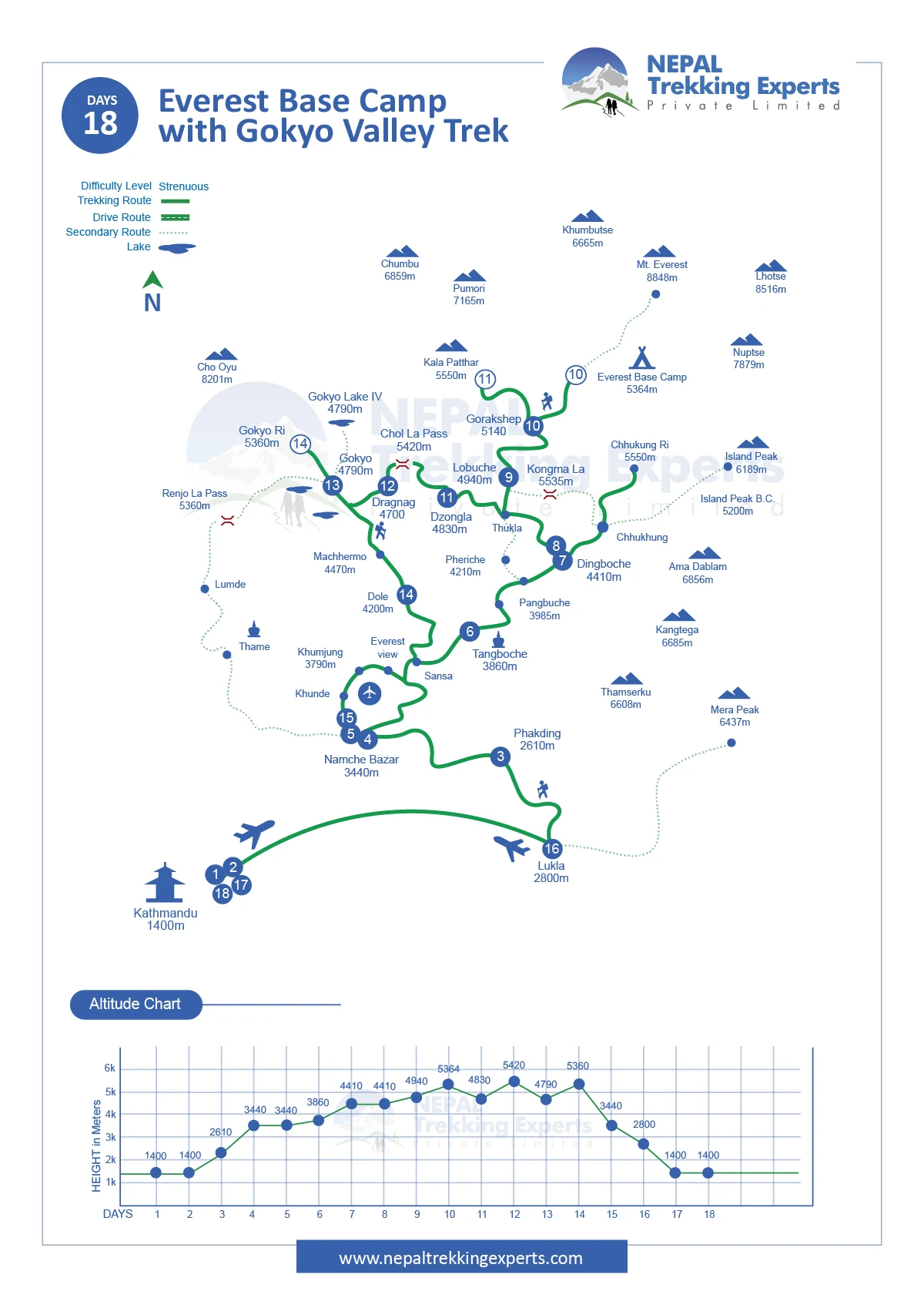
Route MapDownload Map
Everest Base Camp with Gokyo Valley Trek map
Dates & Availability
Start:SaturdayMar 28, 2026
End:TuesdayApr 14, 2026
PriceUS$1790
StatusGuaranteed

Note

Are you satisfied with the group departure dates? Aside from that, we organize private trips or any special dates you prefer. Let's talk to our local specialist now.

Photos & Videos
FAQs for Everest Base Camp with Gokyo Valley Trek
  • The Kala Patthar is 5550 meters/18209 feet above sea level. 

  • The altitude of Everest Base Camp is 5364 meters/ 17598 feet.

  • The elevation of Gokyo Ri is 5360 meters/ 17585 feet.

  • The height of Chola Pass is 5420 meters/ 14830 feet.

  • The Everest Base Camp with Gokyo Lake Trek costs 1100 - 1600 USD per person. It depends on the number of days, group size, service, etc.

  • The Gokyo Lake Trek via Everest Base Camp is considered strenuous trekking in Nepal since you are hiking for many days in high altitudes.

  • You can expect a maximum of 15-20°c for the first couple of days and a minimum of -10 to -15°c during the night in higher altitudes.

  • The best time for the Everest Base Camp with Gokyo Valley Trek is September to November and March to May.

  • The Everest Base Camp Trek with Gokyo Lakes takes 15 - 18 days, 130 Km/81 miles.

  • Yes, you can do the Everest Base Camp with Gokyo Trek solo but for safety and an unforgettable experience, go with a guide or porter.

  • If you go by flight Lukla is the starting point but there is an option to go by driving, it takes some extra days for the trekking.

You may also like
Related Packages
4Travelers' Reviews
  • TripAdvisor
    rating star

    Una experiencia inolvidable

    Decidimos contratar a esta agencia debido a las buenas vibraciones que nos proporcionó desde un principio. Siempre atentos y manteniéndonos informados en todo momento de una forma clara y muy rápida. Una vez en Nepal, donde nos disponíamos a hacer la excursión al campo base del Everest para luego volver pasando por los lagos de Gokyo, nos trataron super bien. Tanto el guía, Ganesh, como el porteador Buddhi Rai son unos perfectos compañeros de viaje. Siempre atentos y haciendo que tu experiencia sea lo mejor posible. Su amabilidad no tiene limites. Si volvemos a Nepal no dudaría en embarcarme en otra aventura montañera con ellos. Aun tenemos alguna partida de cartas y parchís pendientes jeje
    Ya en casa y habiendo pasado unas semanas, aun me parece increíble el haber podido realizar esta excursión. La recomendaría a todo el mundo aunque siempre matizando que aunque no es una excursión técnica, hay que estar preparado para aguantar el caminar a cierta altitud y el frio en algún momento que otro. Pero si eres alguien habituado a realizar excursiones y caminar por la montaña, no dudes en que esta excursión te va a encantar.

    M
    Mike Mica BesenApr 07, 2024Spain
  • TripAdvisor
    rating star

    2 fantastic adventures

    May 2023

    We did a trek with Nepal Trekking Experts in April/May 2023 2x 12 days, Langtang
    /Gosainkund and Basecamp over Gokyo Lake/Chola Pass. It was 2 fantastic tours with magnificent views. Ganesh accompanied us on both treks. He looked after us reliably, competently and very caringly. Even with a critical eye on weather conditions and our well-being, he carefully weighed up whether passes, for example, would be passable or not! Our porters have also done an excellent Job, Gokul on Langtang and Bijaya on basecamp trek. They not only took care of the luggage, but also took care of us attentively. We would like to thank the entire team of Nepal Trekking Experts!!! From arrival to departure everything was optimally organized. We can absolutely recommend the company! Michael and Jana from Germany

    M
    MichaelMay 21, 2023Germany
Call us on WhatsApp+977 9841917136OrChat with us
Consult with a Travel Expert

Do you have any questions about the trips? Contact our travel experts in various countries.

Plan Your TripJoin Our Newsletter