Nepal's Restricted Area Solo Trekking Rules 2026: New Permit Changes, Guide Requirements & Key Updates
Nepal updated its restricted area trekking rules in 2026, officially allowing solo trekkers to enter these regions under a guided system without the need to pay for a ghost trekker permit or join a group, as announced by the Department of Immigration (DOI).
While the rule change is real and significant, it has also created confusion about what solo trekking actually means under the new system. Many trekkers are still unsure whether they can travel completely alone or what level of guidance is required.
For solo travelers, this update is important because it expands access while still maintaining regulated safety measures in some of Nepal’s most remote and sensitive trekking areas. This article breaks down exactly what changed in 2026, what the new rules allow, and what you need to clearly understand before planning a restricted area trek in Nepal.
A Side-By-Side Comparison On Before Vs After: What Has Actually Changed For Solo Trekkers?
Topics
Before
After (2026 updates)
Group Requirements
Minimum 2 foreign trekkers required
Solo trekking allowed (1 person is enough)
Guide Requirements
Licensed guide mandatory
Licensed guide is still mandatory
Minimum Stay & Permit Rules
Fixed minimum trekking permit of 7 to 10 days, pay full permit fee even if fewer days were trekked
No fixed minimum days, pay only for actual trekking days
Permit Processing
Must be processed through a trekking agency
Still must be processed through a registered trekking agency only
Permit Application Basis
Original passport and valid visa required
Can be processed using Visa Application Number
Permit Processing Time
Must wait in Kathmandu (is only processed during working days)
Can be arranged in advance before you arrive in Nepal
Document Collection
Physical document needed after arrival
Pre-approved possible via digital means
TIMS System (where applicable
Green paper-based TIMS card
E-TIMS digital tracking
Travel Insurance
Recommended but not strictly enforced
Now legally mandatory
Can I Trek Solo In Nepal’s Restricted Areas Now? What “Solo Trekking” Actually Means Under The New Rules?
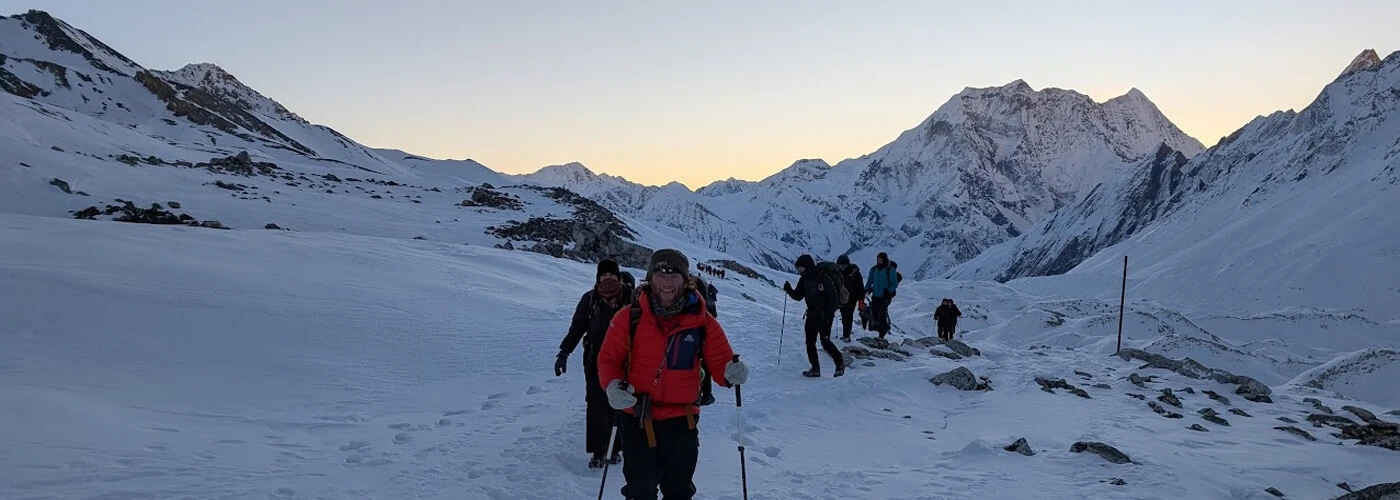
Yes, you can trek alone in Nepal’s restricted trekking regions under the 2026 rules, but “solo trekking” does not mean independent or unguided trekking.
Under the updated policy announced by Nepal’s Department of Immigration in 2026, solo foreign trekkers are no longer required to form a group of two people to obtain restricted area trek permits. This means a single traveler can apply for a permit and enter restricted regions individually. However, trekking must still be done with a licensed guide arranged through a government registered trekking agency.
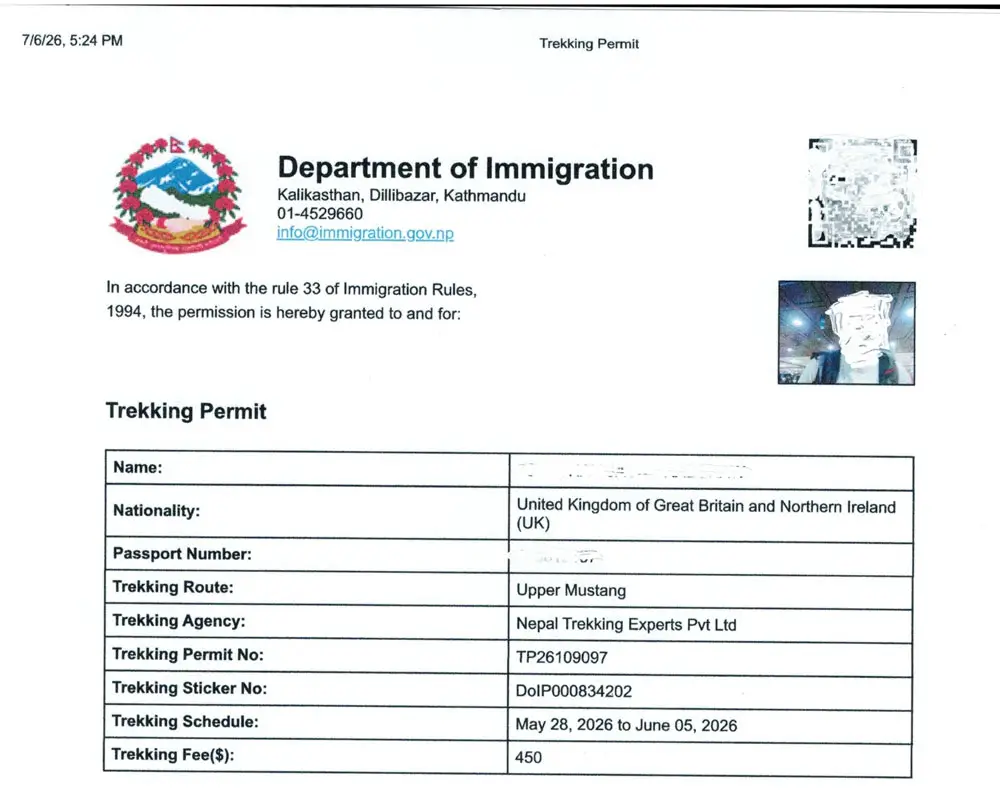
Upper Mustang Solo Trek Permit
In simple terms, “solo trekking” now refers to traveling alone as an individual, not trekking completely independently without support. The rule allows solo entry, but maintains guided travel within restricted areas for safety purposes.
This clarification is important because many travelers misunderstand the 2026 update and assume it allows full independent trekking. In reality, the rule only removed the two-person minimum requirement, not the guided trek.
What Changed In Nepal’s 2026 Solo Trekking Rules?
Guide Requirement Update: 1 Licensed Guide Required For Up To 7 Trekkers In Restricted Areas
Under Nepal’s 2026 trekking rule update, one licensed guide is now required for every group of up to seven trekkers in restricted areas.
The rule means that even solo trekkers must be accompanied by a licensed guide, but the guide can now lead a small group of up to seven people at once. For travelers, this update makes it easier to join small guided groups or travel individually without needing a fixed partner. It also helps reduce costs for group trekkers, while still maintaining proper supervision in high-altitude and restricted zones.
Permit Changes In 2026: Revised RAP System With Digital Application And Agency-Based Processing
This new rule has introduced a fully digital trekking permit system for restricted area travel, making the process faster, more organized, and easier to manage through registered trekking agencies.
You can now begin the permit process in advance from your home country using a Visa Application Submission Number or apply in Nepal using a valid visa number. Once initiated, the official permit application is handled by a licensed trekking agency registered with the Government of Nepal, ensuring all documentation is correctly submitted and approved.
This updated system improves coordination between you, agencies, and authorities by reducing manual paperwork and speeding up approvals. It also allows better planning before arrival in Kathmandu, especially for travelers preparing from abroad.
At entry checkpoints in Nepal’s restricted trekking areas, permits are now verified through the e-TIMS digital system using QR code scanning for quick validation of trekking permits and agency details. While physical copies of permits and documents are strongly recommended as backup, the official verification is done digitally. Screenshots may not always be accepted, so you should carry official permit records and printed copies for smooth clearance.
16 Restricted Area Trekking Regions Covered Under Nepal’s 2026 Solo Trekking Rules
Nepal’s 2026 solo trekking rules apply to around 16 officially designated restricted trekking regions across the country. These are remote Himalayan areas located near international borders or in culturally sensitive zones, where entry is regulated through special permits and guided trekking requirements.
These regions are not closed to trekkers, but they are closely managed to ensure safety, environmental protection, and controlled tourism flow. Under the updated rules, solo travelers can now enter these areas individually, but only with a licensed guide and through a registered trekking agency.
The restricted area trekking regions under Nepal’s 2026 rules are:
Upper Mustang
Upper Dolpo
Lower Dolpo
Manaslu Circuit
Tsum Valley
Nar Phu Valley
Kanchenjunga Region
Humla (Simikot & Limi Valley)
Mugu Region
Bajhang Region
Northern Langtang
Darchula Region
Dolakha (Rolwaling Valley)
Northern Khumbu
Kimathanka / Makalu
What Has Not Changed Under Nepal’s Restricted Area Trekking Rules 2026?
Fixed Permit Fees And Government-Controlled Trekking Zones Remain Unchanged
One important part of Nepal’s 2026 update is that fixed permit fees for restricted area trekking remain unchanged. The cost structure for Restricted Area Permits (RAP) is still set and controlled by the government, depending on the region, season, and duration of stay.
Similarly, trekking zones in these restricted areas continue to be strictly regulated by the government. Entry rules, checkpoint controls, and designated routes have not been unchanged under the new policy, even though solo trekkers can now travel individually with a guide.
For trekkers, this means there are no new cost changes or reduced fees under the 2026 update. Planning a trek still requires budgeting based on existing permit rates and following the same controlled access routes that have been in place for years.
Mandatory Entry Checkpoints And Restricted Area Access Regulations Still Apply
Even with Nepal’s 2026 update allowing solo trekkers under a guided system, mandatory entry checkpoints and restricted area access regulations still fully apply.
You must pass through official checkpoints at different stages of the journey, where authorities verify permits and guide details. These checks are part of Nepal’s long-standing system to monitor movement in remote and sensitive Himalayan regions.
Every restricted area trek still follows controlled entry and exit points, and trekkers are not allowed to bypass designated routes or checkpoints.
Conservation Area Rules And Border-Region Restrictions Remain Strict As Before
This rule also does not change the strict conservation area regulations or border-region restrictions, which remain fully in place as before.
Trekking regions that fall under national parks, conservation areas, or sensitive border zones are still governed by the same environmental and security rules. These include limits on movement, designated trekking routes, and controlled access to protect fragile ecosystems and border security.
Travel Insurance Requirement Remains Mandatory For All Restricted Area Trekkers
Even with the updated solo trekking provisions, travel insurance is still a non-negotiable requirement before permits are approved and issued.
You must carry valid travel insurance that covers high-altitude trekking, emergency medical treatment, and helicopter evacuation from remote Himalayan regions. This is especially important because restricted area treks take place in isolated locations where immediate medical support is limited or unavailable.
What Do These 2026 Changes Mean For Solo Trekkers In Nepal?
Nepal’s 2026 restricted area trekking update makes it easier for solo travelers to visit regions like Manaslu, Dolpo, Upper Mustang, and Kanchenjunga. The previous requirement of forming a group of at least two trekkers has been removed, thus, you can travel solo without needing to pay for a “ghost permit.”
However, you cannot trek to restricted areas completely alone without a guide, nor can you apply for permits without an authorized trekking agency.
Apart from it, the new rule allows permits to be processed in advance using a Visa Application Number before your arrival in Nepal.
Now, if you are planning a solo restricted area trek in 2026, our NTE team assists with permit processing, certified guide arrangements, Application Submission ID support, and full trekking coordination for solo travelers.
So, get in touch with us to plan your trek in Nepal.
FAQs
Can I trek solo in Nepal’s restricted areas in 2026?
Yes, you can apply as a solo traveler, but trekking must still be done with a licensed guide through a registered agency.
What changed in Nepal’s restricted area trekking rules in 2026?
The main change is the removal of the two-person minimum requirement, allowing solo permit applications.
Is a guide still required for restricted area trekking in Nepal?
Yes, a licensed guide is mandatory for all trekkers, including solo travelers, in restricted regions.
Can I apply for a restricted area permit on my own?
No, permits must still be processed through a registered trekking agency, even for solo trekkers.
Is travel insurance required for restricted area trekking?
Yes, high-altitude travel insurance covering emergency evacuation is compulsory for all trekkers.
How many trekkers can one guide lead in restricted areas?
One licensed guide can now lead up to seven trekkers under the 2026 update.
Which areas are covered under Nepal’s restricted area rules?
Regions like Manaslu, Upper Mustang, Dolpo, Kanchenjunga, and Tsum Valley fall under the restricted system.
Does the 2026 rule allow completely independent trekking?
No. Independent, unguided trekking is still not allowed in restricted areas.
This is Mr. Rajesh, also known as Raj. I was born and raised in the mountain region of Manaslu and have a deep and abiding connection with the culture and nature of the Himalayan mountains. With more than 25 years in the trekking industry and having traveled most of the trekking trails available in Nepal, I have a deep affinity and connection to the broad spectrum of people and their cultures, as well as a deep appreciation for the various religions, history, flora, and fauna of the mountain regions and their scattered valleys.