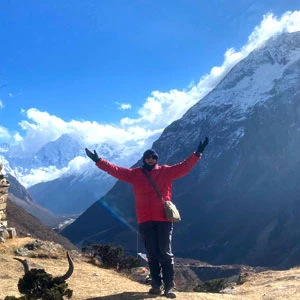
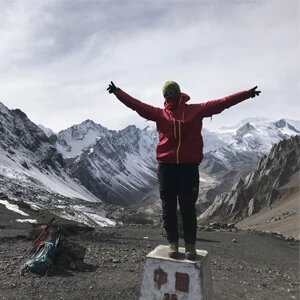
Yala Peak Climbing

Experience the Langtang Valley Trek with Yala peak climbingratingbased on 1 review
  • Duration13 Days
  • Difficulty Level Strenuous
  • Activity Trekking and Climbing
  • Max. Altitude 5500m
  • Starts Kathmandu
  • Ends Kathmandu
  • Group Size 1-12
  • Best Season March to May and September to November
Group Discount Prices
  
1 paxUS$1390
2 - 3 paxUS$1245
4 - 7 paxUS$1190
8 - 12 paxUS$1090
Yala Peak Climbing Highlights
  • Summit the beginner-friendly Yala Peak (5,500 meters) and experience your first Himalayan peak climbing adventure.
  • Combine the scenic Langtang Valley Trek with an unforgettable Yala Peak expedition.
  • Witness breathtaking sunrise views over Langtang Lirung, Shishapangma, Dorje Lakpa, Ganchenpo, Naya Kanga, and surrounding Himalayan peaks from the summit.
  • Trek through the pristine landscapes of Langtang National Park, including rhododendron forests, alpine meadows, glaciers, and diverse Himalayan wildlife.
  • Hike through traditional Tamang villages and immerse yourself in the rich Tibetan-influenced culture.
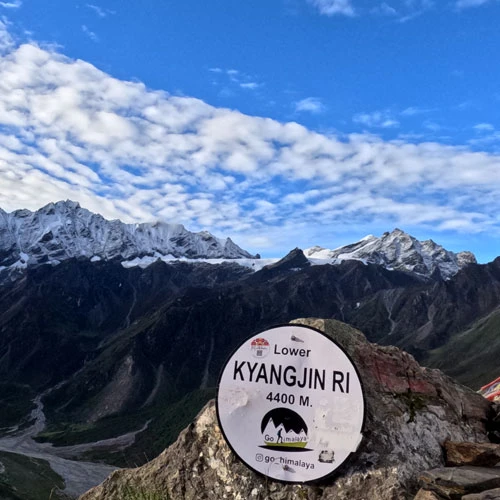
  • Spend an acclimatization day at Kyanjin Gompa and hike to Kyanjin Ri for spectacular panoramic mountain views.
  • Enjoy panoramic views of the Langtang Himalayan range and the Tibetan Plateau from one of Nepal's most accessible trekking peaks.
  • Perfect opportunity to test essential mountaineering skills with your stamina before your summit attempt with experienced Sherpa climbers.
  • Stay in authentic Himalayan tea houses, home stays, and camps while trekking through some of Nepal's most peaceful and less-crowded mountain trails.

Yala Peak Climbing Overview

Yala Peak Climbing is a rewarding Himalayan adventure that combines the scenic Langtang Valley Trek with the thrill of summiting one of Nepal's most accessible trekking peaks. Rising to 5,500 meters in Nepal's Langtang region near the Tibetan border, Yala Peak is classified as a trekking peak. Unlike Nepal's major expedition mountains that demand advanced technical skills and weeks of climbing, it is designed for adventurous trekkers looking to take their first step into Himalayan mountaineering. Thus, Yala Peak stands out as one of the most beginner-friendly options.

Yala Peak has long been recognized as one of Nepal's classic introductory climbing destinations. Following the establishment of Nepal's trekking peak permit system by the Nepal Mountaineering Association (NMA), it became a popular choice for someone wishing to progress from high-altitude hiking to peak climbing. Today, it is one of the most sought-after trekking peaks in the Langtang Himalayas.

With this journey, you gradually transition into a real Himalayan climbing adventure. Beginning with a scenic drive from Kathmandu, the trail winds through lush forests, cascading waterfalls, suspension bridges, and traditional Tamang villages before entering the breathtaking landscapes of Langtang National Park. As you climb higher, the dense woodlands give way to alpine meadows, glacial valleys, and rugged mountain terrain, eventually leading to Kyanjin Gompa, which is the final permanent settlement before the climb.

This approach through the Langtang Valley allows your body to acclimatize naturally while introducing you to the region's rich culture, diverse landscapes, and Himalayan lifestyle. After an acclimatization hike and climbing preparation at Kyanjin Gompa, you then continue to Yala Peak Base Camp before setting out on a pre-dawn summit push under the guidance of experienced climbing Sherpas.

Beyond the climb itself, the journey is filled with unforgettable cultural and natural experiences. Colorful prayer flags flutter beneath towering snow-capped peaks, ancient Buddhist monasteries preserve centuries-old traditions, and yak caravans continue to traverse the trails. The warm hospitality of the Tamang people here also adds another memorable dimension to the adventure.

Summit day is the culmination of days of trekking, acclimatization, and anticipation. As dawn breaks over the Himalayas, you stand atop Yala Peak with breathtaking views of Langtang Lirung, Shishapangma, Dorje Lakpa, Ganchenpo, Naya Kanga, and countless surrounding peaks stretching across the Nepal-Tibet frontier. You get the satisfaction of completing a journey that combines trekking, culture, and your first true Himalayan summit.
Lastly, if you wish to get more details on the trekking section, please go through our Langtang Valley Trek package. 

Why Choose Yala Peak Summit In Nepal?

Experience The Best Of The Langtang Valley Trek And Yala Peak Summit

This trek allows you to experience the spiritual, cultural, and everyday life of the Langtang region before stepping onto the mountain itself.

At Kyanjin Gompa, you can visit the centuries-old Buddhist monastery that sits beneath towering Himalayan peaks. The sound of prayer wheels, fluttering prayer flags, and the peaceful atmosphere of the village provide a meaningful glimpse into the spiritual traditions of the Tamang community here.

The village is also home to the famous Kyanjin Cheese Factory. It is one of the highest-altitude cheese factories in Nepal. Visiting the factory gives you a chance to see how local yak cheese is produced and to support the mountain community through local tourism.

One of the highlights before the climb is the hike to Kyanjin Ri. Reaching this viewpoint rewards you with sweeping panoramas of the Langtang Himalayas and serves as an excellent acclimatization hike before moving toward Base Camp.

Trekking through Langtang also carries a deeper significance. The region was heavily affected by the devastating 2015 earthquake, and tourism remains an important source of income for local families. By visiting the valley, staying in local tea houses, and using local services, you directly contribute to the ongoing recovery and livelihood of the people of Langtang.

Another memorable part of the adventure is the overnight stay at Yala Peak Base Camp. As the sun sets behind the mountains, the campsite becomes surrounded by glaciers, rugged ridges, and an incredible night sky filled with stars. The camping experience adds a true expedition atmosphere that is very different from the tea house trekking days earlier in the journey.

Finally comes the summit push. Starting before dawn with headlamps and climbing gear, you make your way steadily upward alongside your climbing Sherpa. Reaching the summit of Yala Peak is a deeply rewarding moment. You get spectacular Himalayan views and the satisfaction of completing your first genuine Himalayan climbing adventure.

Short, Easy to Reach, and Budget-Friendly Climbing

Due to its location in the Langtang region, this journey is both accessible and affordable. Hence, it is an excellent choice if you are looking to complete your first Himalayan climb without committing to a lengthy or expensive expedition.

Yala Peak is reached entirely by road. Your adventure begins with a scenic drive from Kathmandu to Syabrubesi, the gateway to the Langtang Valley. Once you arrive in Syabrubesi, the trail gradually leads you through the stunning Langtang Valley.

The expedition is also well-suited to travelers with limited time. Over the course of 13 days, you get to experience a rewarding combination of trekking, cultural exploration, acclimatization, and peak climbing without needing to spend several weeks in the mountains. 

Similarly, Yala Peak is equally attractive if you are seeking a budget-friendly Himalayan adventure. Since the expedition doesn't require domestic flights or lengthy expeditions, many of the major costs associated with higher and more technical peaks are significantly reduced. 

Despite being one of Nepal's more accessible and affordable trekking peaks, Yala Peak never compromises on the experience. You still trek through the breathtaking landscapes of Langtang National Park, immerse yourself in the rich culture of the Tamang people, acclimate in the picturesque village of Kyanjin Gompa, and stand atop a 5,500 meters Himalayan summit surrounded by spectacular views.

One Of Nepal's Best Beginner-Friendly Trekking Peaks

If you have always dreamed of standing on a Himalayan summit but have little or no climbing experience, Yala Peak is one of the best places to begin. Recognized as one of Nepal's most beginner-friendly trekking peaks, it offers aspiring climbers the opportunity to experience high-altitude mountaineering in a supportive and achievable setting. While reaching the summit still requires commitment, physical fitness, and determination, the expedition is designed to help first-time climbers gain confidence without the demands of highly technical alpine climbing.

One of the main reasons Yala Peak is ideal for beginners is its gradual progression. This particular expedition follows the scenic Langtang Valley, allowing your body to acclimatize naturally as you gain altitude. It gives you time to adapt physically and mentally before the summit push. By the time you reach Kyanjin Gompa and continue to Base Camp, you already have several days of high-altitude trekking behind you.

Another advantage is that Yala Peak provides an authentic introduction to Himalayan mountaineering without requiring advanced technical climbing skills. Under the guidance of experienced climbing Sherpas, you learn how to use essential climbing equipment, understand summit procedures, and travel confidently in a high-altitude mountain environment. 

That said, beginner-friendly doesn't mean effortless. Climbing to 5,500 meters involves trekking at high altitude, walking for long hours, and maintaining a good level of physical fitness. The thinner air, colder temperatures, and early morning summit push can be demanding, even for experienced trekkers. Therefore, you need proper preparation, a sensible pace, and the support of knowledgeable guides.

Witness Spectacular Himalayan Views from the Yala Peak Summit

During this expedition, the mountain views begin the moment you enter the Langtang Valley and become increasingly dramatic with every step you take. From lush river valleys and forested hillsides to glaciers, alpine landscapes, and snow-covered peaks, the expedition offers a constantly evolving panorama that makes the journey just as memorable as standing on the summit itself.

Here, the first few days of trekking from Syabrubesi to Sherpa Gaun and beyond, you follow trails through dense rhododendron and bamboo forests, cross suspension bridges over glacial rivers, and pass cascading waterfalls tucked into the valley. The towering Langtang Lirung, the highest mountain in the Langtang region, occasionally emerges above the trees. As you continue climbing, the forests gradually thin, the valley opens up, and the surrounding peaks become larger and more imposing.

By the time you reach Kyanjin Gompa, the landscape has transformed into a breathtaking alpine world of glacial valleys, rugged cliffs, yak pastures, and towering Himalayan giants. This picturesque village sits beneath the impressive walls of Langtang Lirung and serves as one of the finest viewpoints in the region. 

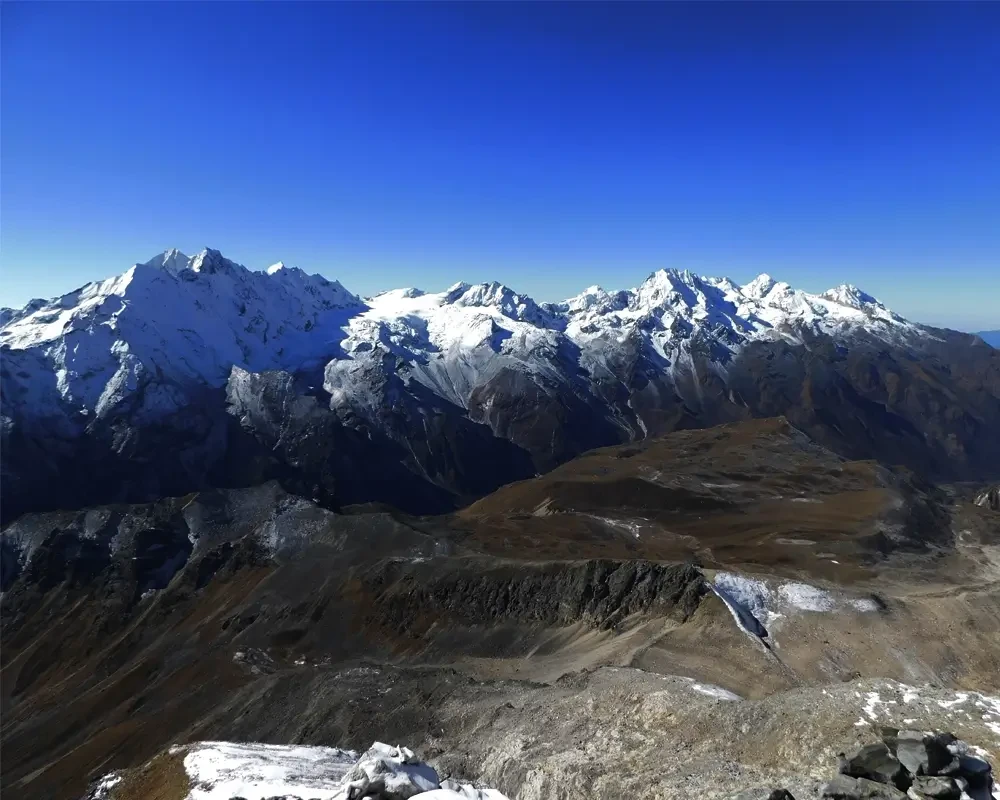
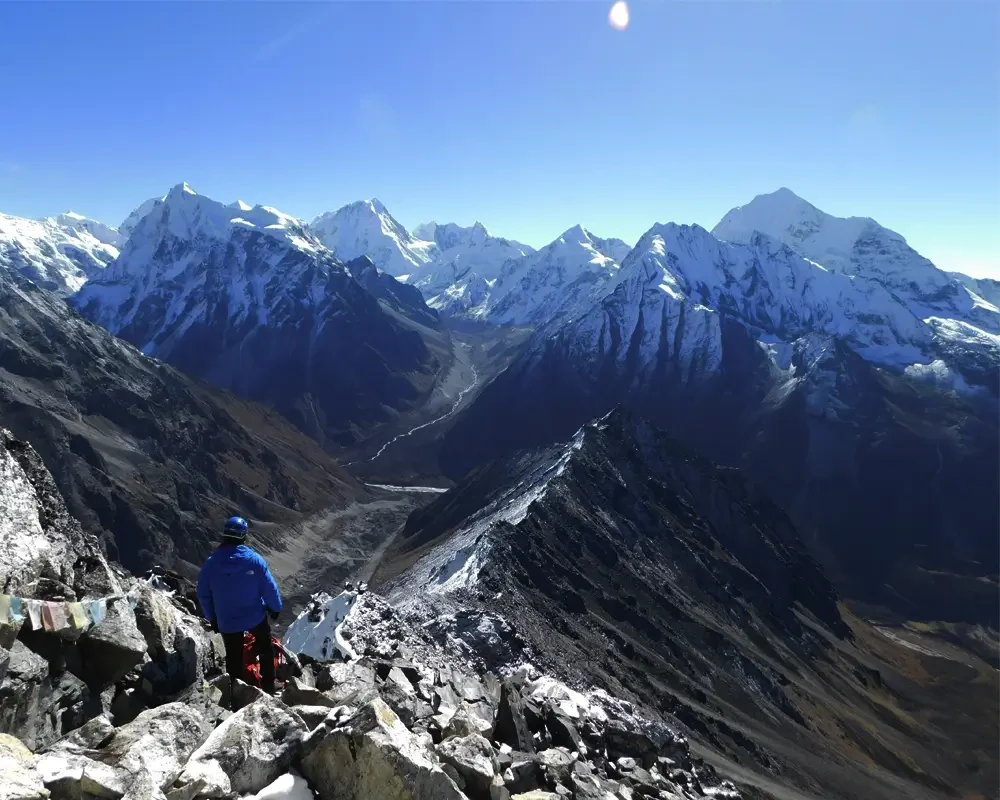
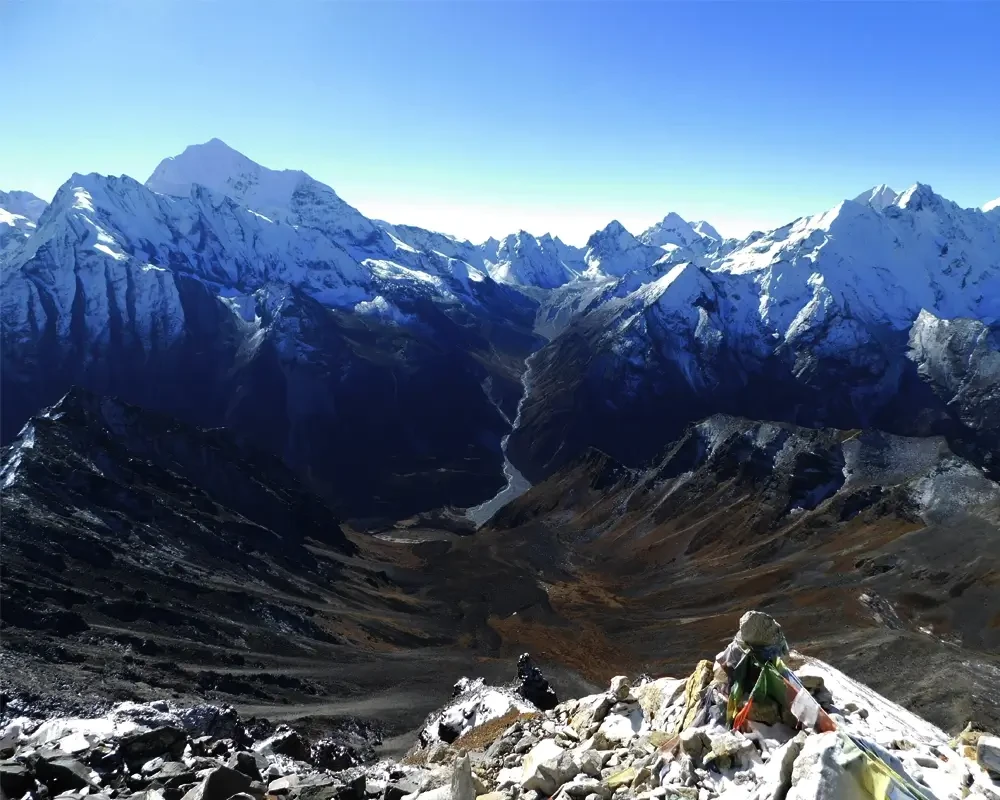
During your acclimatization day, the hike to Kyanjin Ri rewards you with sweeping views over the Langtang Valley, the Langtang Glacier, and an incredible amphitheater of snow-covered peaks. On clear days, you also get to admire Ganchenpo, Langtang Ri, Naya Kanga (Ganja La Chuli), Langshisha Ri, Surya Peak, and Leonpo Peak.

As you continue toward Yala Peak Base Camp, the scenery becomes even more rugged and remote. Vegetation gives way to rocky moraines, alpine tundra, seasonal snowfields, and glacial terrain, while uninterrupted mountain views accompany nearly every step. The closer you get to the summit, the more expansive the landscape becomes, revealing the immense scale of the Langtang Himalayas.

Summit day offers the most breathtaking panorama of the entire expedition. You set out long before sunrise and climb beneath a sky filled with stars. As dawn breaks, the mountains gradually glow with shades of gold, orange, and soft pink. Reaching the 5,500 meters summit of Yala Peak rewards you with spectacular 360-degree views stretching across Nepal and Tibet. 

From the summit, you witness Langtang Lirung, the sacred Shishapangma (the only 8,000-meter mountain located entirely within Tibet), along with Dorje Lakpa, Ganchenpo, Langtang Ri, Naya Kanga, Langshisha Ri, the distant Ganesh Himal Range, and countless unnamed snow-covered ridges extending toward the Tibetan Plateau.

Experience The Unique Tamang And Tibetan Culture Of The Langtang Valley

While reaching the summit is the ultimate goal of Yala Peak Climbing, the journey through the Langtang Valley is equally rewarding for its rich cultural heritage. Home to the indigenous Tamang people, this region offers an authentic glimpse into a Himalayan way of life that has been preserved for centuries. This region is deeply influenced by Tibetan Buddhism due to its proximity to the Nepal-Tibet border.

As you trek through villages such as Sherpa Gaun, Thangsyap, and Kyanjin Gompa, you encounter traditional stone houses, intricately carved wooden windows, colorful prayer flags fluttering in the mountain breeze, and centuries-old monasteries that reflect the valley's strong Buddhist identity. Along the trails, you also pass mani walls carved with sacred Buddhist mantras, chortens (stupas), and spinning prayer wheels, all of which hold deep spiritual significance.

Similarly, the people you meet along the route primarily belong to the Tamang ethnic community, which is one of Nepal's oldest Himalayan indigenous groups. Historically, the Tamang people maintained close trade and cultural ties with Tibet, and those influences are still visible today in their language, architecture, customs, cuisine, and religious traditions. Most local residents here speak the Tamang language, with several regional dialects found throughout the valley. Nepali is also widely spoken, and English is commonly understood by guides, lodge owners, and those working in tourism.

Daily life in the Langtang Valley revolves around the mountains. Families have traditionally relied on yak and livestock herding, potato and barley farming, cheese production, and operating family-run tea houses. As you stay in these locally owned lodges, you get to experience genuine Himalayan hospitality while gaining insight into a lifestyle. 

One of the region's most famous local specialties is yak cheese that is produced at the historic cheese factory near Kyanjin Gompa. You can also visit this factory and sample fresh Himalayan cheese made using traditional methods.

If your journey coincides with local celebrations, you may also witness vibrant cultural festivals such as Sonam Lhosar, the Tamang New Year, or Buddha Jayanti. During these occasions, local communities gather in beautifully woven traditional attire adorned with handcrafted jewelry, while monasteries come alive with prayers, ceremonial rituals, music, and traditional dances.

Following the devastating 2015 earthquake, many villages in this region were severely affected. Through determination and community effort, local residents have rebuilt their homes, monasteries, tea houses, and trekking infrastructure while preserving their traditions and cultural identity. Therefore, visiting the region also supports the livelihoods of the communities that continue to protect and celebrate it.

Useful Information

Langtang Valley Trek Yala Peak Climbing Package Cost

The cost of the Yala Peak package is USD 1,390 per person. This price is designed to offer excellent value for a complete Himalayan adventure that combines the scenic Langtang Valley Trek with a guided ascent of Yala Peak.

The package covers all the major logistics required for the expedition, including licensed trekking and climbing guides, accommodation during the trek, meals, ground transportation between Kathmandu and Syabrubesi, permits, climbing support, and essential organizational services. 

It's important to note that personal expenses such as snacks, soft drinks, hot showers, Wi-Fi, charging fees, tips for guides and porters, travel insurance, and any rental gear not included in the package are generally paid separately.

Do I Need a Climbing Permit for Yala Peak?

No, you do not need a separate climbing permit for Yala Peak. Unlike many of Nepal's other trekking peaks, Yala Peak currently does not require a dedicated climbing permit. Its non-technical climbing route and relatively moderate altitude of 5,732 meters have made the permit process much simpler.

However, you must obtain a Langtang National Park Entry Permit, as the entire expedition takes place within Langtang National Park. The permit currently costs NPR 3,000 per person and is mandatory for all trekkers entering the protected area. The permit fee directly supports the conservation of the park's diverse wildlife, alpine forests, glaciers, trekking trails, waste management initiatives, and local community development.

Although Yala Peak was previously associated with Nepal's trekking peak permit system, the current regulations no longer require a separate climbing permit. This makes Yala Peak one of the most convenient trekking peaks for first-time climbers.

When you book your Yala Peak Climbing adventure with Nepal Trekking Experts, we take care of all the required permit arrangements on your behalf. Our team obtains your Langtang National Park Entry Permit before the trek and ensures all documentation complies with the latest government regulations. Since trekking policies and permit fees can occasionally change, we also keep you updated with the most current requirements.

Guide, Porter, And Climbing Guide Costs For Yala Peak

For a safe and comfortable Yala Peak experience, you must hire a licensed trekking guide and, if desired, a porter to carry part of your luggage. The climbing guide for the summit section is arranged separately, as it requires specialized mountaineering skills and equipment handling.

The cost of a trekking guide is USD 35 per day, while a porter costs USD 25 per day. A porter can usually carry up to 20 kg of luggage, making the trek significantly easier and allowing you to conserve energy for the summit ascent.

The climbing guide (climbing Sherpa) is a separate service from the trekking guide and is assigned specifically for the Yala Peak summit attempt. The climbing guide is responsible for route management, safety procedures, equipment checks, and technical support during the ascent.

Now, tipping is not included in the package price. In Nepal, tipping guides, porters, and climbing staff is considered an important part of trekking culture and is highly appreciated by local crews. Normally, people tip more or less 10—20% of the total trip cost, depending on your satisfaction with the service provided.

How to Book the Yala Peak Trek in Nepal?

Booking your Yala Peak Climbing adventure with Nepal Trekking Experts is simple, secure, and hassle-free. Once you have chosen your preferred departure date, all you need to do is confirm your reservation by paying a 10% deposit of the total trip cost. This allows us to secure your booking and begin arranging the necessary logistics for your expedition, including permits, accommodation, transportation, and guide services.

To complete your booking, please send us a copy of your valid passport, one recent passport-sized photograph, and your flight details (if available at the time of booking).

For your convenience, you can submit the deposit securely through our website using our online payment system. The payment process is fully encrypted and secure, and once your transaction is complete, you automatically receive a confirmation receipt in your email. The remaining balance can be paid upon your arrival in Kathmandu before the trek begins.

After your booking is confirmed, our team stays in touch to help you prepare for your Yala Peak adventure. We provide detailed pre-trip information, answer your questions, assist with equipment recommendations, and ensure you have everything you need for a smooth and enjoyable expedition.

If you need a customized itinerary, have special travel requirements, or simply want to learn more about the trip before booking, feel free to contact us at any time. 

How Difficult Is It To Climb Yala Peak?

Yala Peak Climbing is widely regarded as one of Nepal's easiest and most beginner-friendly trekking peaks. However, that doesn't mean it's an easy walk to the summit. Standing at 5,732 meters above sea level, Yala Peak presents the challenges that naturally come with climbing at high altitude. While you don't need previous mountaineering experience or advanced technical climbing skills, you do need good physical fitness, mental resilience, and proper preparation to successfully reach the top.

Unlike many of Nepal's technical climbing peaks, Yala Peak follows a relatively straightforward ascent under normal weather conditions. The route is generally non-technical, allowing fit trekkers to attempt the summit with the guidance of experienced climbing Sherpas. 

Depending on seasonal snow and ice conditions, you may use basic mountaineering equipment such as crampons, a helmet, a harness, or ropes during certain sections of the climb. Before the summit push, your climbing guide provides a safety briefing and demonstrates how to use the equipment correctly.

For most climbers, altitude is the greatest challenge. As you ascend above 5,000 meters, the air contains significantly less oxygen, making even gentle uphill sections feel more demanding. You may find yourself walking at a slower pace, taking frequent breaks, and feeling tired more quickly than at lower elevations. This is why the itinerary includes a dedicated acclimatization day at Kyanjin Gompa, allowing your body to gradually adapt to the thinner air before continuing toward Base Camp and the summit. 

Summit day is the most physically demanding yet rewarding part of the expedition. You begin the climb well before sunrise, trekking under a sky full of stars in cold alpine conditions. As you gain elevation, every step requires more effort due to the thinner air, but the gradual pace and continuous support from your climbing Sherpa help make the ascent manageable.

Although Yala Peak is considered one of Nepal's shortest peak climbing expeditions, it still requires commitment. The climbing portion begins after reaching Kyanjin Gompa, where you spend an acclimatization day before trekking to Yala Peak Base Camp. From there, you make an early morning summit push and descend back to Kyanjin Gompa on the same day. 

Overall, if you regularly hike, maintain an active lifestyle, and prepare well before the trip, you are well-positioned to enjoy this incredible Himalayan adventure. 

Yala Peak Altitude Profile And Acclimatization

Reaching the summit of Yala Peak is an exciting achievement, but success depends on more than physical fitness alone. The biggest challenge during Yala Peak Climbing is adapting to the increasing altitude. As you gain elevation, the air becomes thinner and contains less oxygen, making even simple activities feel more demanding. That's why this expedition follows a carefully planned itinerary through the Langtang Valley, allowing your body to acclimatize gradually before the final summit push.

Rather than gaining elevation too quickly, the itinerary is structured to give your body time to adjust before moving above 4,500 meters. The most important acclimatization stop is Kyanjin Gompa, where an extra day is built into the schedule before proceeding toward Base Camp.

On this acclimatization day, you hike to Kyanjin Ri, reaching approximately 4,700 to 4,800 meters before descending to sleep again at Kyanjin Gompa. This follows the proven mountaineering principle of "climb high, sleep low", which helps stimulate altitude adaptation while reducing the strain of spending the night at a higher elevation.

After acclimatization, you then continue to Yala Peak Base Camp, located at approximately 4,800 to 4,900 meters, before making your summit push in the early hours of the following morning. By this stage, your body has already spent several days gradually adapting to the altitude, significantly improving your chances of reaching the summit safely and comfortably.

Although the itinerary is designed to minimize altitude-related risks, it's still important to understand the symptoms of Acute Mountain Sickness (AMS). Mild symptoms can include headache, dizziness, fatigue, nausea, loss of appetite, difficulty sleeping, and shortness of breath during exertion. These symptoms should never be ignored. Your guide regularly monitors your condition throughout the trek, and if necessary, the itinerary can be adjusted to prioritize your safety. Remember, reaching the summit is never more important than your health.

You can further improve your acclimatization by maintaining a slow and steady pace, drinking plenty of water, eating nutritious meals, getting enough rest, and avoiding alcohol and smoking during the expedition. Following your guide's instructions and listening to your body are among the most effective ways to reduce the risk of altitude sickness.

Best Time To Climb Yala Peak

The best time to climb Yala Peak is during spring (March to May) and autumn (September to November), when the Langtang region enjoys stable weather, clear Himalayan views, comfortable temperatures, and excellent climbing conditions.

In spring, the valleys come alive with blooming rhododendron forests, lush landscapes, and pleasant trekking weather. Among the spring months, April is the most recommended as it offers warmer temperatures, longer daylight hours, stable weather, and ideal snow conditions on the upper slopes, creating the perfect balance for both trekking and climbing. 

Autumn is equally ideal, bringing crisp air, dry trails, and exceptional mountain visibility after the monsoon. October is widely regarded as the best month for Yala Peak Climbing, due to its crystal-clear skies, highly stable weather, and the highest likelihood of favorable summit conditions. 

Although winter (December to February) is possible, it is generally not recommended due to freezing temperatures, heavy snowfall, icy trails, and shorter daylight hours, which make the climb more demanding. Likewise, the monsoon season (June to August) is the least favorable because of frequent rainfall, slippery trails, poor mountain visibility, leeches at lower elevations, and occasional landslides affecting road access.

Now, if you are deciding between the two peak seasons, October is generally considered the best overall month, offering the clearest Himalayan panoramas and the most stable weather. However, if you prefer vibrant landscapes and blooming rhododendron forests, April is an equally rewarding choice.

Preparation Tips And Training For Yala Peak Expedition

  • Build a strong cardiovascular base through activities such as hiking, brisk walking, running, cycling, or swimming at least 8 to 12 weeks before the expedition.
  • Focus on improving endurance rather than speed, as long days of trekking at high altitude require sustained stamina.
  • Include regular uphill hiking or stair climbing while carrying a loaded daypack to simulate trekking conditions.
  • Strengthen your legs, core, back, and shoulders with exercises such as squats, lunges, step-ups, planks, and deadlifts.
  • Practice walking for consecutive days to prepare your body for multiple days of trekking without extended rest.
  • If possible, complete one or two multi-day hikes before your trip to gain confidence and test your fitness.
  • Gradually break in your trekking boots well before departure.
  • Train with the clothing and backpack you intend to use on the trek to ensure comfort and proper fit.
  • Learn the early signs and symptoms of altitude sickness and understand the importance of reporting them immediately to your guide.
  • Follow the itinerary without rushing.
  • Stay well hydrated throughout the trek and maintain a nutritious, carbohydrate-rich diet.
  • Get sufficient sleep before and during the expedition.
  • Avoid alcohol, smoking, and unnecessary overexertion during the trek.
  • Prepare mentally for early morning starts, changing mountain weather, basic tea house accommodation, and physically demanding summit day.
  • Familiarize yourself with basic climbing equipment such as crampons, a harness, a helmet, trekking poles, and ropes, even though your climbing guide provides instruction before the summit.
  • Ensure your travel insurance covers trekking and peak climbing above 5,700 meters, including emergency helicopter evacuation.
  • Pack only essential gear to keep your backpack light.
  • Schedule your trip during April or October if possible, as these months typically offer the most stable weather and the highest chances of a successful summit.

What Meals Can I Expect With the Yala Peak Climbing Package?

The package includes three meals a day: breakfast, lunch, and dinner. Most tea houses also serve tea or coffee with breakfast, while a selection of hot beverages is available throughout the day.

The menus along the Langtang Valley offer a satisfying mix of traditional Nepali cuisine and popular Western dishes. At lower elevations, you enjoy a wider selection, while the menu becomes simpler as you climb higher. Despite the remote location, the meals are freshly cooked, hygienic, and designed to provide the nutrition needed for trekking at high altitude.

Breakfast usually includes options such as Tibetan bread, chapati, toast with butter, jam or honey, pancakes, porridge, muesli, hash browns, fried potatoes, and eggs prepared boiled, fried, scrambled, or as an omelet. These are typically accompanied by black tea, milk tea, coffee, hot chocolate, or hot lemon, giving you plenty of energy to start the day.

Lunch and dinner menus are generally similar and offer a wide variety of hearty meals, including Dal Bhat, fried rice, fried noodles, chow mein, thukpa (Tibetan noodle soup), momo (dumplings), pasta, macaroni, pizza in larger villages like Kyanjin Gompa, soups, and potato dishes. As you gain altitude, the selection may become more limited, but the quality and nutritional value remain excellent.

Among all the dishes, Dal Bhat is the most recommended meal for trekkers and climbers. Consisting of steamed rice, lentil soup, seasonal vegetables, pickles, and curry, it provides an ideal balance of carbohydrates, protein, vitamins, and minerals needed for sustained energy at high altitude. Many tea houses also offer free unlimited refills. There's a reason trekkers across Nepal proudly say, "Dal Bhat Power, 24 Hour."

While trekking through Kyanjin Gompa, don't miss the opportunity to try the region's famous yak cheese. Produced using traditional methods at the local Himalayan cheese factory, it has a rich, distinctive flavor and is one of the Langtang Valley's most popular local specialties. 

In addition to tea and coffee, most tea houses serve a variety of beverages, including ginger tea, lemon tea, green tea, mint tea, hot chocolate, garlic soup, soft drinks, bottled water, and occasionally fresh juices where available. Hot drinks are especially popular at higher elevations, helping you stay warm and hydrated in the cool mountain climate.

Vegetarian meals are widely available throughout the trek, and most tea houses can also accommodate vegan, gluten-free, or other dietary requirements with prior notice. If you have any food allergies or special dietary preferences, simply let Nepal Trekking Experts know before your trip, and we do our best to arrange suitable meals throughout your adventure.

Is Safe Drinking Water Available Along The Route?

Yes, safe drinking water is readily available, but you should avoid drinking untreated tap, river, or stream water, as it may contain bacteria and other harmful microorganisms that can cause illness.

The safest and most commonly recommended option is boiled drinking water, which is available at nearly all tea houses along the Langtang Valley. Many lodges also offer filtered or purified water, while bottled mineral water can be purchased in most villages. However, bottled water becomes more expensive as you gain altitude and contributes to plastic waste, so we encourage you to carry a reusable water bottle or insulated flask that can be refilled with boiled water throughout the journey.

For added convenience, it's also a good idea to bring water purification tablets, purification drops, or a portable water filter. These help you treat water from natural sources during the trek.

Staying hydrated is especially important at high altitude. The combination of thinner air, dry mountain climate, and continuous physical activity increases the risk of dehydration, which can also make acclimatization more difficult. We recommend drinking 3 to 4 liters of water per day, and even more on strenuous days such as the summit push.

Tea Houses And Lodges Along The Langtang Trail

During this adventure, you stay in traditional tea houses and family-run lodges that offer a comfortable and authentic Himalayan experience. Accommodation is available at every overnight stop along the route, including Syabrubesi, Sherpa Gaun, Thangsyap, and Kyanjin Gompa. At Yala Peak Base Camp, you typically spend the night in a basic tented camp, preparing for your early morning summit attempt.

Most tea houses provide clean twin-sharing rooms with beds, mattresses, pillows, and blankets. The rooms are simple and functional. As you gain altitude, accommodation generally improves. While Lama Hotel and Riverside offer simpler rooms with basic facilities, the lodges in Langtang Village and Kyanjin Gompa provide more comfortable bedrooms, and many also have private bathrooms. 

One of the highlights of staying in the Langtang Valley is spending your evenings in the communal dining hall, where trekkers gather around a warm stove to enjoy freshly prepared meals, share stories from the trail, and interact with fellow adventurers and local hosts. These family-run tea houses also offer a wonderful opportunity to experience the genuine hospitality, traditions, and mountain lifestyle of the Tamang communities.

What Facilities Are Available During The Trek?

Bathrooms And Hot Showers

Bathroom and hot shower facilities are available at most tea houses along the Langtang Trail, although the standard varies depending on the village and altitude. Nowadays, apart from Syabrubesi, even higher villages offer more modern facilities with better quality than the lower elevation.

Most tea houses have shared bathrooms, with a mix of Western-style flush toilets and traditional squat toilets. The facilities are generally clean and well maintained by lodge owners, though the standard may vary depending on the season and the number of trekkers staying at the lodge.

Hot showers are available in many villages, including Syabrubesi and Kyanjin Gompa, but they usually come at an additional cost. Depending on the lodge, showers may be gas-heated, solar-heated, or provided as a bucket of hot water. As fuel and supplies must be transported into the mountains, the cost of hot showers typically increases with altitude. At Yala Peak Base Camp, shower facilities are generally unavailable due to the temporary camping setup.

To stay comfortable throughout the trek, we recommend packing a small toiletries kit, a quick-drying towel, biodegradable soap, hand sanitizer, wet wipes, and toilet paper, as these items may not always be provided by the tea houses.

Wi-Fi And Mobile Reception

Staying connected is much easier than you expect. Up to Kyanjin Gompa, wifi, mobile reception, and NTC mobile data generally work well. Most villages on the trail have reliable connectivity.  

Many tea houses and lodges provide Wi-Fi for an additional fee, particularly in larger settlements such as Syabrubesi and Kyanjin Gompa. 

For mobile connectivity, Nepal Telecom (NTC) generally offers the best coverage in the Langtang region and is recommended over Ncell, whose signal becomes less consistent at higher elevations. Although you have mobile reception in many parts of the trek, there may be sections with weak or no signal, especially beyond Kyanjin Gompa and around Yala Peak Base Camp.

If you plan to stay connected during the trek, consider purchasing a local NTC SIM card in Kathmandu before your departure.

Charging Facilities

Charging facilities are available at most tea houses and lodges along the Langtang Trail, allowing you to recharge essential devices such as your phone, camera, smartwatch, and power bank. Most lower and higher-altitude villages nowadays receive electricity from hydropower. Having said that, electricity availability may vary depending on weather conditions.

In most tea houses, charging is available for an additional fee, with prices generally increasing as you gain altitude due to the higher cost of generating and supplying electricity. Charging points are commonly located in the communal dining area.

Before leaving Kyanjin Gompa for Yala Peak Base Camp, we recommend fully charging all your electronic devices, as charging facilities at Base Camp are generally unavailable due to the temporary camping setup. Carrying a high-capacity power bank, spare camera batteries, charging cables, and a universal travel adapter is also highly recommended to ensure your devices remain powered throughout the expedition.

Transportation Options And Costs For The Yala Peak Trip

Your Yala Peak adventure begins with a scenic drive from Kathmandu to Syabrubesi, the gateway to the Langtang region and the starting point of the trek. This overland journey takes you from Nepal's bustling capital through terraced hillsides, rivers, traditional villages, and beautiful mountain landscapes before reaching the trailhead. Depending on your budget and travel preferences, you can choose between a local bus or a private jeep.

The local bus is the most economical option and is widely used by both locals and budget trekkers. Buses depart early in the morning from Gongabu Bus Park and take approximately 7 to 8 hours, depending on road and weather conditions. The ride is basic, with frequent stops along the way, but it offers an authentic glimpse into everyday life in rural Nepal. The fare is approximately USD 10 per person.

If you prefer greater comfort and flexibility, a private jeep is the recommended choice. The journey usually takes 6 hours and includes hotel pickup in Kathmandu, more comfortable seating, and the option to stop for meals, photos, or short breaks whenever needed. A private jeep costs around USD 130 per vehicle.

After completing your trek and summit, you return from Syabrubesi to Kathmandu using the same route. Both local buses and private jeeps are available for the return journey, and transportation can be arranged according to your itinerary and travel preferences.

Why Is Travel Insurance Essential for Yala Peak Adventure?

Although Yala Peak is one of Nepal's most beginner-friendly peak climbing adventures, it is still a high-altitude expedition reaching 5,732 meters. Weather conditions can change quickly, and the remote Himalayan environment means access to advanced medical facilities is limited. For these reasons, comprehensive travel insurance is strongly recommended and considered essential for every climber.

A suitable insurance policy protects you against unexpected situations such as altitude sickness, injuries, illness, emergency medical treatment, trip interruptions, weather-related delays, and rescue operations. 

Most importantly, your policy should include trekking and peak climbing coverage up to at least 5,732 meters, as well as emergency helicopter evacuation, emergency medical expenses, hospitalization, and rescue costs. Many standard travel insurance policies exclude high-altitude trekking or climbing, so it's important to carefully check the maximum altitude covered before purchasing your policy.

In the event of a serious medical emergency, such as severe altitude sickness or an accident, helicopter evacuation may be the fastest and safest way to reach appropriate medical care. Without adequate insurance, rescue and evacuation costs can amount to thousands of US dollars.

Before traveling to Nepal, purchase your insurance policy, carry both digital and printed copies, and share your insurance details with your trekking company. 

Currency, ATMs, And Payment Options In Nepal

The official currency of Nepal is the Nepalese Rupee (NPR), and it is the primary form of payment throughout your adventure. While Kathmandu has modern banking facilities and accepts various payment methods, the remote Langtang region relies almost entirely on cash.

Kathmandu has numerous banks, ATMs, and licensed money exchange counters, where you can withdraw or exchange major foreign currencies into Nepalese Rupees. We recommend carrying small denominations, as tea houses and local shops may have limited change.

Although Syabrubesi may have limited ATM services, they are not always reliable, and there are no dependable ATMs once you begin trekking into the Langtang Valley. For this reason, you should withdraw enough cash in Kathmandu to cover all personal expenses for the duration of the trip.

Hotels, restaurants, and larger businesses in Kathmandu generally accept major credit and debit cards, although some may charge a small transaction fee. Along the trekking route, however, cash is the preferred and often the only accepted payment method. Personal expenses are typically paid in cash. 

The amount of cash you need depends on your personal spending habits, but it's wise to budget around USD 150 for personal or any unexpected expenses. 

Nepal Visa Information For Yala Peak Climbers

You require a tourist visa to enter Nepal for Yala Peak Climbing. Fortunately, Nepal offers a simple and straightforward visa process, and citizens of many countries are eligible for a Visa on Arrival at Tribhuvan International Airport in Kathmandu as well as selected land border entry points.

To obtain a Nepal tourist visa, you generally need a passport valid for at least six months, at least one blank passport page, a completed visa application or arrival form, and the applicable visa fee according to the latest immigration regulations. Although digital photographs are often taken during the application process, carrying a few recent passport-sized photos is recommended as a backup.

Nepal offers tourist visas for different lengths of stay. Before traveling, it's a good idea to check that your passport has sufficient validity and select a visa duration that comfortably covers your trip.

While the Visa on Arrival is available for most nationalities, travelers from certain countries may need to obtain a visa before arriving in Nepal. Since immigration policies can change, we recommend checking the latest entry requirements with the Department of Immigration Nepal or the nearest Nepalese embassy or consulate before your departure.

Why Book Your Yala Peak Climbing Adventure With Nepal Trekking Experts?

Choosing the right trekking company can make all the difference to your Yala Peak Climbing experience. At Nepal Trekking Experts, we combine local expertise, professional service, and a strong commitment to safety to ensure your Himalayan adventure is both memorable and hassle-free.

As a government-registered and certified trekking operator, we are affiliated with leading tourism organizations, including the Trekking Agencies' Association of Nepal (TAAN), the Nepal Mountaineering Association (NMA), and the Nepal Tourism Board (NTB). These registrations ensure that your trek is operated legally, ethically, and in accordance with Nepal's national tourism and trekking standards.

Your safety is our highest priority. Our experienced guides and support staff are licensed, insured, and professionally trained in high-altitude trekking, first aid, and emergency response. They regularly participate in training programs and field updates.

With years of experience leading treks in the Langtang region, we have built strong relationships with local communities and tea house owners. These local connections provide smoother logistics, warm hospitality, and genuine opportunities to experience the traditions, culture, and daily life of the Tamang people beyond what most visitors see.

When you book with Nepal Trekking Experts, you are also supporting responsible and sustainable tourism. Your trip directly benefits local guides, porters, family-run tea houses, and mountain communities, helping create employment opportunities while contributing to the long-term development of the Langtang region.

To make your preparation easier, we also provide complimentary trekking gear support if you are missing essential equipment.

Above all, our reputation is built on trust, transparency, and exceptional customer service. With hundreds of 5-star reviews on TripAdvisor and positive feedback from trekkers around the world, we are proud to be one of Nepal's trusted trekking companies for unforgettable Himalayan adventures.

Yala Peak Climbing Gear And Packing List

Clothing:

  • Moisture-wicking base layers (top and bottom)
  • Lightweight trekking shirts
  • Trekking pants
  • Thermal inner layers
  • Fleece jacket or softshell jacket
  • Insulated down jacket
  • Waterproof and windproof outer jacket (Gore-Tex or equivalent)
  • Waterproof trekking pants
  • Lightweight shorts
  • Warm hat or wool beanie
  • Sun hat or cap
  • Buff or neck gaiter
  • Balaclava 
  • Warm gloves (insulated)
  • Undergarments
  • Sleepwear

Footwear:

  • Several pairs of trekking socks
  • Thermal socks
  • Waterproof, well-broken-in trekking boots with good ankle support
  • Lightweight camp shoes or sandals
  • Gaiters
  • Microspikes (optional, depending on season and guide recommendation)

Climbing Gear:

  • Backpack (30 to 40 L) for daily essentials
  • Duffel bag (provided by many trekking companies if using a porter)
  • Trekking poles
  • Climbing helmet
  • Climbing harness
  • Crampons
  • Ice axe (if required by conditions)
  • Locking and non-locking carabiners
  • Ascender and descender (if required)
  • Climbing sling
  • Safety rope (provided by the expedition team)
  • Sleeping bag rated to at least -15°C to -20°C
  • Headlamp with extra batteries
  • High-capacity power bank
  • Universal travel adapter
  • Charging cables
  • Spare camera batteries
  • Reusable water bottles (2 to 3 liters total capacity)
  • Insulated water bottle or thermos
  • Water purification tablets, drops, or a portable water filter
  • Sunglasses with UV400 protection (Category 3 or 4)
  • Sunscreen (SPF 50+)
  • Lip balm with SPF
  • Dry bags or waterproof stuff sacks
  • Rain cover for backpack
  • Snacks and energy bars for summit day

Personal Items:

  • Passport and photocopies
  • Passport-sized photographs
  • Travel insurance documents
  • Trekking permits and travel documents
  • Cash in Nepalese Rupees (NPR)
  • Personal first aid kit
  • Prescription medications
  • Altitude medication (if advised by your doctor)
  • Pain relievers
  • Blister treatment kit
  • Hand sanitizer
  • Biodegradable soap
  • Toothbrush and toothpaste
  • Quick-drying towel
  • Toilet paper
  • Wet wipes
  • Tissues
  • Nail clipper
  • Comb or hairbrush
  • Moisturizer
  • Insect repellent (mainly useful at lower elevations)
  • Earplugs
Yala Peak Climbing Itinerary
  • Overnight Altitude:1400 meters/4593 feet
  • Accommodation:3 star hotel

Namaste and welcome to Nepal! Upon your arrival at Tribhuvan International Airport in Kathmandu, one of our friendly representatives from Nepal Trekking Experts greets you with a traditional flower garland and a warm Himalayan welcome. After a brief introduction, you are transferred to your hotel in the heart of the city.

Today is reserved for relaxation after your journey, giving you time to recover from jet lag and settle into your new surroundings before your Yala Peak Climbing adventure begins. Depending on your arrival time, you can simply unwind at the hotel or take a leisurely stroll through the vibrant streets of Kathmandu. Explore nearby local markets, browse traditional handicraft shops, sample authentic Nepali cuisine, or soak up the lively atmosphere of this historic capital city.

  • Overnight Altitude:1400 meters/4593 feet
  • Meals:Breakfast
  • Accommodation:3 star hotel

Today is dedicated to the final preparation day in Kathmandu. After enjoying breakfast at your hotel, a representative from Nepal Trekking Experts meets you and escorts you to our office for a comprehensive pre-trip briefing.

Here, you meet Rajesh, the founder of Nepal Trekking Experts, who personally walks you through the expedition. During the meeting, you receive detailed information about the trekking route, daily itinerary, trail conditions, altitude profile, weather expectations, safety procedures, and what to expect during summit day. This is also the perfect opportunity to ask any last-minute questions before heading into the Himalayas.

A thorough gear inspection follows to ensure you have all the essential clothing and climbing equipment for the expedition. If anything is missing, don't worry, we recommend reliable trekking shops in Kathmandu where you can rent or purchase quality gear. Your guide is happy to assist you with shopping, exchanging currency, withdrawing cash from ATMs, or any other preparations you may need before departure.

Once everything is ready, the rest of the day is yours to enjoy. Kathmandu is home to several remarkable UNESCO World Heritage Sites that offer a wonderful introduction to Nepal's history, culture, and spirituality. You can visit Swayambhunath Stupa (Monkey Temple), a hilltop shrine famous for its panoramic views of the Kathmandu Valley and its playful monkeys. 

There is also Boudhanath Stupa, which is one of the largest Buddhist stupas in the world, and provides a peaceful atmosphere where pilgrims circle the white dome while spinning prayer wheels. Pashupatinath Temple is Nepal's most sacred Hindu temple, situated on the banks of the Bagmati River, and offers a fascinating glimpse into centuries-old religious traditions and rituals.

If you are interested in Nepal's rich architectural heritage, you can also explore Kathmandu Durbar Square, known for its historic palaces, temples, and courtyards, or take a short drive to Patan Durbar Square, celebrated for its exquisite Newari craftsmanship and ancient temples. Another excellent option is Bhaktapur Durbar Square, a beautifully preserved medieval city renowned for its traditional brick streets, intricate wood carvings, pottery, and timeless cultural charm. Whether you choose to visit these sites before or after your trek.

In the evening, you gather for a welcome dinner, where you have the chance to get to know your climbing guide and, if you are traveling in a group, meet your fellow trekkers.

  • Overnight Altitude:1503 meters/4932 feet
  • Meals:Breakfast, Lunch and Dinner
  • Accommodation:Tea house

After an early breakfast at your hotel, you leave Kathmandu and travel north to Syabrubesi, the gateway to the Langtang region and the starting point of your trek. Throughout the drive, your trekking guide is with you to ensure everything runs smoothly and to assist whenever needed.

As you leave the Kathmandu Valley behind, the busy cityscape gradually gives way to peaceful countryside, terraced hillsides, and winding mountain roads. The journey begins on well-paved highways and continues through the Himalayan foothills on roads that are generally in good condition. Even the off-road sections are smooth enough for comfortable travel, with no particularly bumpy stretches along the route. Throughout the drive, you can enjoy changing landscapes of rivers, forests, traditional villages, and mountain views.

One of the highlights of today's journey is following the Trishuli River, whose turquoise waters accompany much of the route. Along the way, you pass charming villages, lush forests, cultivated farmlands, cascading waterfalls, and dramatic river gorges. On clear days, you even catch your first distant views of the surrounding Himalayan foothills.

Several stops are made throughout the drive for tea, lunch, and restroom breaks, giving you time to stretch your legs, enjoy local Nepali cuisine, and take in the ever-changing landscapes. These breaks also provide an excellent opportunity to experience the warm hospitality of small roadside communities before venturing into the mountains.

As you approach Syabrubesi, the air becomes noticeably cooler and fresher, and the scenery transforms into dense forests, rushing rivers, and towering green hills that mark the entrance to Langtang National Park. By late afternoon or early evening, you arrive at this peaceful riverside village, where you check into a traditional tea house and settle in for your first night in the Himalayas.

  • Overnight Altitude:2563 meters/8409 feet
  • Meals:Breakfast, Lunch and Dinner
  • Accommodation:Tea house

With a breakfast in Syabrubesi, the trail leaves the main river route and begins a steady climb toward the higher villages of the Langtang region. This upper route is one of the most rewarding alternatives on the trek because it offers wider mountain views, traditional Tamang culture, and a quieter atmosphere compared to the lower riverside path.

The day starts with a gradual ascent through terraced fields where local farmers grow millet, corn, and seasonal vegetables. Stone-paved sections lead through ancient Tamang settlements, and you will pass traditional houses built from wood and stone, decorated with prayer flags and Buddhist symbols. The trail is generally in good condition, with a mix of stone steps, compact dirt paths, and forest tracks. Some sections are steeper than the lower river route, but the footing is secure, and there are plenty of places to rest.

As you gain elevation, the surrounding landscape changes noticeably. Dense forests of oak, pine, and rhododendron begin to replace the cultivated terraces. Birdsong echoes through the trees, and on clear days, you may catch glimpses of snow-covered peaks appearing between the forest openings.

The highlight of the day comes when you reach Khanjim. From this viewpoint, the horizon suddenly opens up, revealing impressive views of the Himalayas, such as Langtang Lirung, Ganesh Himal, and the surrounding mountain ridges become visible.

From Khanjim, the trail continues with a few more uphill sections before gradually easing toward Sherpa Gaun. Although this upper route involves more uphill terrain than the river route, you find that the panoramic scenery makes the effort feel much easier. 

After several hours of trekking, you arrive at Sherpa Gaun, a quiet hillside settlement known for its peaceful atmosphere and warm local hospitality. After checking into your tea house, you can relax, enjoy a freshly prepared dinner, and soak in the beautiful mountain surroundings.

  • Overnight Altitude:3140 meters/10301 feet
  • Meals:Breakfast, Lunch and Dinner
  • Accommodation:Tea house

Wake up to the crisp mountain air and enjoy breakfast before continuing deeper into the Langtang Valley. Today's scenery becomes increasingly alpine as you gain altitude.

Leaving Sherpa Gaun, the trail winds through beautiful forests of pine, oak, fir, and rhododendron, with occasional clearings revealing stunning views of the surrounding Himalayan peaks. Compared to the previous day, the valley begins to feel more open and remote, while the towering mountains appear closer with every step.

As you descend briefly, you reconnect with the main Langtang Valley trail near the banks of the Langtang Khola. Following the glacial river upstream, you pass several small settlements and resting points before reaching Rimche, where you may pause for lunch and refreshments.

From here, the trail gradually climbs through dense woodland and dramatic river gorges before arriving at Lama Hotel, which is a well-known stopover nestled in the forest. This section offers excellent opportunities to spot wildlife within Langtang National Park, including Himalayan langurs, colorful pheasants, and, if you are exceptionally fortunate, the elusive red panda that inhabits these forests.

Beyond Lama Hotel, the landscape slowly begins to transform. The dense forests start to thin, revealing wider valleys and increasingly spectacular mountain views. Langtang Lirung dominates the skyline, while neighboring peaks and rugged cliffs rise dramatically above the valley. The fresh mountain air and the sound of the rushing Langtang Khola accompany you throughout the day's walk.

After several hours of trekking, you reach Thangshep, a peaceful riverside settlement surrounded by towering forests and Himalayan scenery.

  • Overnight Altitude:3830 meters/12565 feet
  • Meals:Breakfast, Lunch and Dinner
  • Accommodation:Tea house

Today is one of the most rewarding days as you leave the forest behind and enter the spectacular upper Langtang Valley. The scenery changes dramatically, with dense woodlands giving way to wide alpine meadows, glacial landscapes, and towering Himalayan peaks that surround you from every direction.

The trail follows the Langtang Khola, gradually climbing through open valleys and traditional yak pastures. Along the way, you pass the rebuilt Langtang Village that was devastated during the 2015 earthquake and has since been lovingly restored by its local residents. Walking through the village offers a meaningful opportunity to witness both the strength of the local people and the remarkable recovery of the region.

Beyond Langtang Village, the valley widens, revealing breathtaking views of snow-covered peaks, rocky cliffs, and expansive alpine terrain. Prayer flags flutter in the mountain breeze, while colorful mani walls, chortens, and prayer wheels reflect the strong Buddhist traditions that continue to shape daily life in the Langtang Valley.

As you continue higher, you pass through the small settlement of Mundu before making the final ascent to Kyanjin Gompa, the cultural and spiritual heart of the Langtang region. Nestled beneath towering Himalayan giants, this picturesque village is surrounded by some of Nepal's most spectacular mountain scenery, including Langtang Lirung, Langshisha Ri, Dorje Lakpa, Ganchenpo, Yala Peak, Naya Kanga, and several other snow-capped summits that dominate the skyline.

Kyanjin Gompa is named after its centuries-old Buddhist monastery, where monks continue their daily prayers amid a peaceful mountain setting. If time permits, you can explore the monastery, wander through the village, or visit the famous Kyanjin Yak Cheese Factory, where locally produced Himalayan cheese has been made using traditional methods for decades.

  • Overnight Altitude:3830 meters/12565 feet
  • Meals:Breakfast, Lunch and Dinner
  • Accommodation:Tea house

Today's acclimatization day is one of the most important parts of your itinerary. Rather than taking a complete rest, you follow the golden rule of high-altitude trekking: climb high, sleep low. This allows your body to gradually adapt to the thinner air while significantly reducing the risk of altitude sickness before the summit push.

Early in the morning, you set out on a rewarding hike to Kyanjin Ri (approximately 4,400 meters). The trail climbs steadily above Kyanjin Gompa, becoming steeper as you gain elevation. Although the ascent is physically demanding, every step is rewarded with increasingly spectacular views of the Langtang Himalayas.

From the summit of Kyanjin Ri, you enjoy one of the finest panoramic viewpoints in the region. On a clear day, the breathtaking 360-degree panorama includes Langtang Lirung, Yala Peak, Dorje Lakpa, Ganchenpo, Langshisha Ri, Naya Kanga, Changbu, Yubra, and the vast Langtang Glacier stretching through the valley below. Looking down over Kyanjin Gompa from above also gives you a true appreciation of how far you have already come on your journey.

After spending time enjoying the scenery and capturing unforgettable photographs, you descend back to Kyanjin Gompa for lunch and a well-earned rest.

The afternoon is dedicated to preparing for the most exciting stage of the expedition. After an early dinner, you organize your backpack, fill your water bottles, and get to bed early. A good night's rest is essential, as the following day you trek to Yala Peak Base Camp.

  • Overnight Altitude:4600 meters/15092 feet
  • Meals:Breakfast, Lunch and Dinner
  • Accommodation:Tent/Camping

Today's journey is shorter than previous trekking days, allowing you to conserve energy while continuing to acclimatize to the increasing altitude.

The trail gradually climbs above the Langtang Valley, leaving behind yak pastures and alpine meadows as the landscape becomes more rugged and glacial. Vegetation becomes increasingly sparse, replaced by rocky moraines, loose scree, and open mountain terrain. Throughout the ascent, spectacular views surround you, with Langtang Lirung, Ganchenpo, Naya Kanga, Langshisha Ri, Dorje Lakpa, and the surrounding snow-covered peaks creating an unforgettable Himalayan backdrop.

After several hours of trekking, you arrive at Yala Peak Base Camp, a peaceful campsite nestled beneath the mountain you will soon climb. After settling into camp and enjoying lunch, the afternoon is dedicated to final preparations for summit day.

Here, you meet your experienced climbing Sherpa, who leads you during the summit attempt. Together, you review the climbing plan, expected weather and snow conditions, the summit route, safety procedures, and the schedule for the early morning ascent. Your Sherpa also conducts a final inspection of your climbing equipment, ensuring your harness, crampons, helmet, ice axe, headlamp, and warm clothing are properly fitted and ready for use.

If you are new to peak climbing, there's no need to worry. Your climbing Sherpa demonstrates how to use the technical equipment correctly, explain important climbing techniques, and answer any last-minute questions, helping you feel confident and fully prepared for the challenge ahead.

As evening falls, enjoy an early dinner and take in the incredible mountain scenery surrounding Base Camp. With countless stars illuminating the Himalayan sky and the excitement of summit day just hours away, you organize your gear, prepare your backpack, and head to bed early.

  • Overnight Altitude:3830 meters/12565 feet
  • Meals:Breakfast, Lunch and Dinner
  • Accommodation:Tea house

Today is the highlight of your Yala Peak Climbing adventure, the long-awaited summit day. Your day begins well before dawn with an early wake-up call at around 2:00 AM. After a light breakfast and a hot drink, you make the final preparations, put on your climbing gear, switch on your headlamp, and begin the ascent under a sky filled with stars.

Accompanied by your experienced climbing Sherpa, you steadily make your way up the mountain, following rocky slopes, snowfields, and gradual glacial terrain. Depending on seasonal conditions, crampons and other technical equipment may be required during the final sections of the climb. Although Yala Peak is considered one of Nepal's best beginner-friendly trekking peaks, the thin air and freezing temperatures make the ascent both physically and mentally demanding.

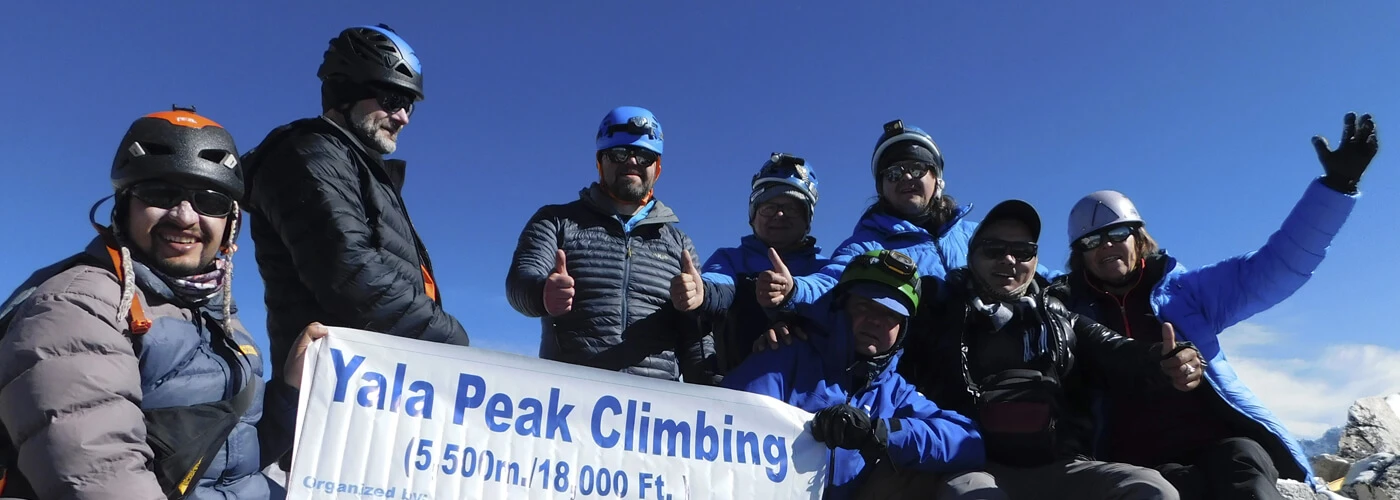
As dawn breaks, the surrounding Himalayas gradually glow with shades of gold, orange, and pink, creating one of the most unforgettable sunrises you ever witness. After several hours of climbing, you reach the summit of Yala Peak, where you are rewarded with breathtaking panoramic views of the Langtang Himalayas.

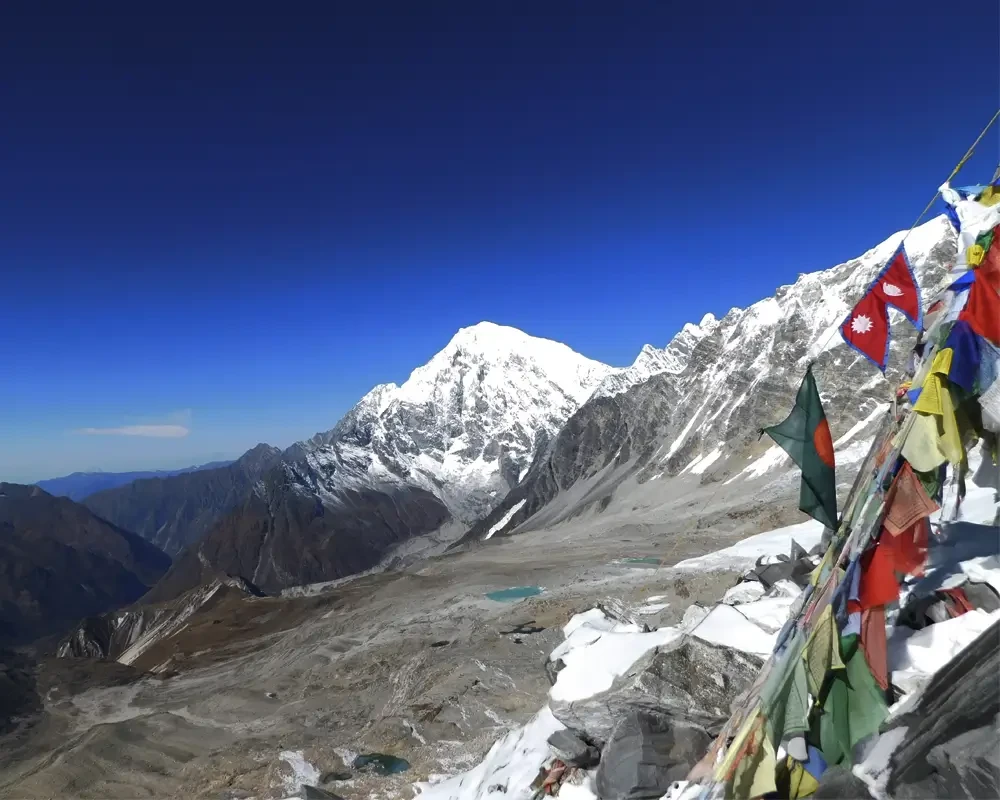
From the summit, admire magnificent peaks including Shishapangma in Tibet, the only 8,000-meter mountain located entirely within China, along with Langtang Lirung, Dorje Lakpa, Ganchenpo, Langshisha Ri, Naya Kanga, Leonpo Peak, Surya Peak, the Ganesh Himal Range, and countless snow-covered summits stretching across the horizon.

After celebrating your achievement, taking photographs, and soaking in the incredible scenery, you carefully descend back to Yala Peak Base Camp before continuing onward to Kyanjin Gompa. Following a long but rewarding day, you enjoy a well-deserved hot meal and a comfortable night's rest.

  • Overnight Altitude:2800 meters/9186 feet
  • Meals:Breakfast, Lunch and Dinner
  • Accommodation:Tea house

After yesterday's successful summit, today is a welcome day of descent as you retrace your steps down the beautiful Langtang Valley. Following breakfast, you leave Kyanjin Gompa and begin a gradual downhill trek through alpine meadows, yak pastures, and glacial landscapes.

The return journey offers a fresh perspective on the trail as you pass Mundu and Langtang Village, where you once again experience the warm hospitality of the local Tamang community. As you descend, the landscape gradually transforms from open alpine terrain back into lush forests of pine, bamboo, and rhododendron.

Towering above the valley, Langtang Lirung continues to dominate the skyline while the rushing Langtang Khola accompanies you throughout much of the day. The lower elevation also brings richer vegetation and better opportunities to spot Himalayan birds and wildlife within Langtang National Park.

By late afternoon, you arrive at Riverside, a peaceful stop surrounded by forests and flowing mountain streams.

  • Overnight Altitude:1503 meters/4931 feet
  • Meals:Breakfast, Lunch and Dinner
  • Accommodation:Tea house

Today marks the final day of trekking as you continue descending toward Syabrubesi, where your Himalayan walking adventure began. The trail follows the Langtang Khola, crossing suspension bridges and passing through dense forests, waterfalls, and charming mountain settlements.

As you lose altitude, the air becomes warmer and the surrounding hills greener. The familiar sounds of flowing rivers, birdsong, and rustling forests accompany your final walk through Langtang National Park, offering one last opportunity to appreciate the region's incredible natural beauty.

By afternoon, you arrive back in Syabrubesi, where you can finally trade your trekking boots for comfortable shoes and enjoy a well-earned rest.

  • Overnight Altitude:1400 meters/4593 feet
  • Meals:Breakfast and Lunch
  • Accommodation:3 star hotel

After breakfast, you bid farewell to the Langtang region and begin the scenic drive back to Kathmandu by local bus or private jeep, depending on your chosen package.

Following the same winding mountain roads, you travel alongside the Trishuli River, passing traditional villages, terraced hillsides, waterfalls, and beautiful rural landscapes. Although the journey is long, it provides a final opportunity to admire Nepal's diverse countryside before returning to the capital.

Upon arriving in Kathmandu, you are transferred to your hotel, where you can enjoy a hot shower, relax after your mountain adventure, or explore the city's lively streets one last time. If time allows, it's also the perfect opportunity to shop for souvenirs, visit local cafés, or celebrate your successful summit with a traditional Nepali meal.

  • Meals:Breakfast

After an unforgettable journey through the Langtang Himalayas and the successful ascent of Yala Peak, your adventure comes to an end today.

Depending on your flight schedule, you may have some free time to enjoy a final breakfast, take a short walk around Kathmandu, or pick up any last-minute souvenirs before departure.

At the designated time, a representative from Nepal Trekking Experts transfers you to Tribhuvan International Airport, ensuring you arrive comfortably and on time for your international flight.

We sincerely thank you for traveling with Nepal Trekking Experts and look forward to welcoming you back for another Himalayan adventure in the future. Safe travels!

Got a question about this tour?

Or looking for customize trip, reach out to our travel experts.

Customize Trip

Note

We have designed our itinerary very balance with good acclimatize way. If you are not satisfied with any aspect, please feel free to customize your own.

What's Included
Cost Includes
  • Complimentary airport pick—up and drop—off
  • Complimentary welcome dinner
  • Three-night 3—star hotel in Kathmandu with breakfast included.
  • All necessary trekking permits/climbing permit, etc.
  • All accommodations during the trek
  • Three meals a day during the trek
  • A cup of tea or coffee with the meal.
  • Fresh fruit each day if and when available
  • Complimentary duffel bag, trekking map, down jacket, and sleeping bag
  • Government-registered and first-aid-trained professional local guide who speaks English
  • A professional climbing Sherpa.
  • First-aid kit
  • Return road transport to and from Syabrubensi by bus/van
  • Staff insurance, meals, accommodation, equipment, transportation, etc.
  • Rescue arrangements if necessary
  • Agency service charge and government tax/VAT
  • Certificate of achievement if needed
Cost Excludes
  • International airfare and Nepal visa fee
  • Lunch and dinner in Kathmandu
  • Porters to carry your backpacks (Normally, a porter works for two people, and he carries 20 kilos. If you choose a shared porter, you can give 10 kilos per person. A porter costs $200 in total. A porter enhances your experience in the Himalayas and adds extra value on the journey.)
  • Personal Insurance, personal expenses, loss of property and theft, etc.
  • Sightseeing costs in the city. (temples, monasteries, etc.)
  • All beverages, snacks, and additional expenses such as laundry, hot showers, battery charging, wifi, etc.
  • Additional cost due to natural calamities and unforeseen circumstances
  • Tips to staff
Route MapDownload Map
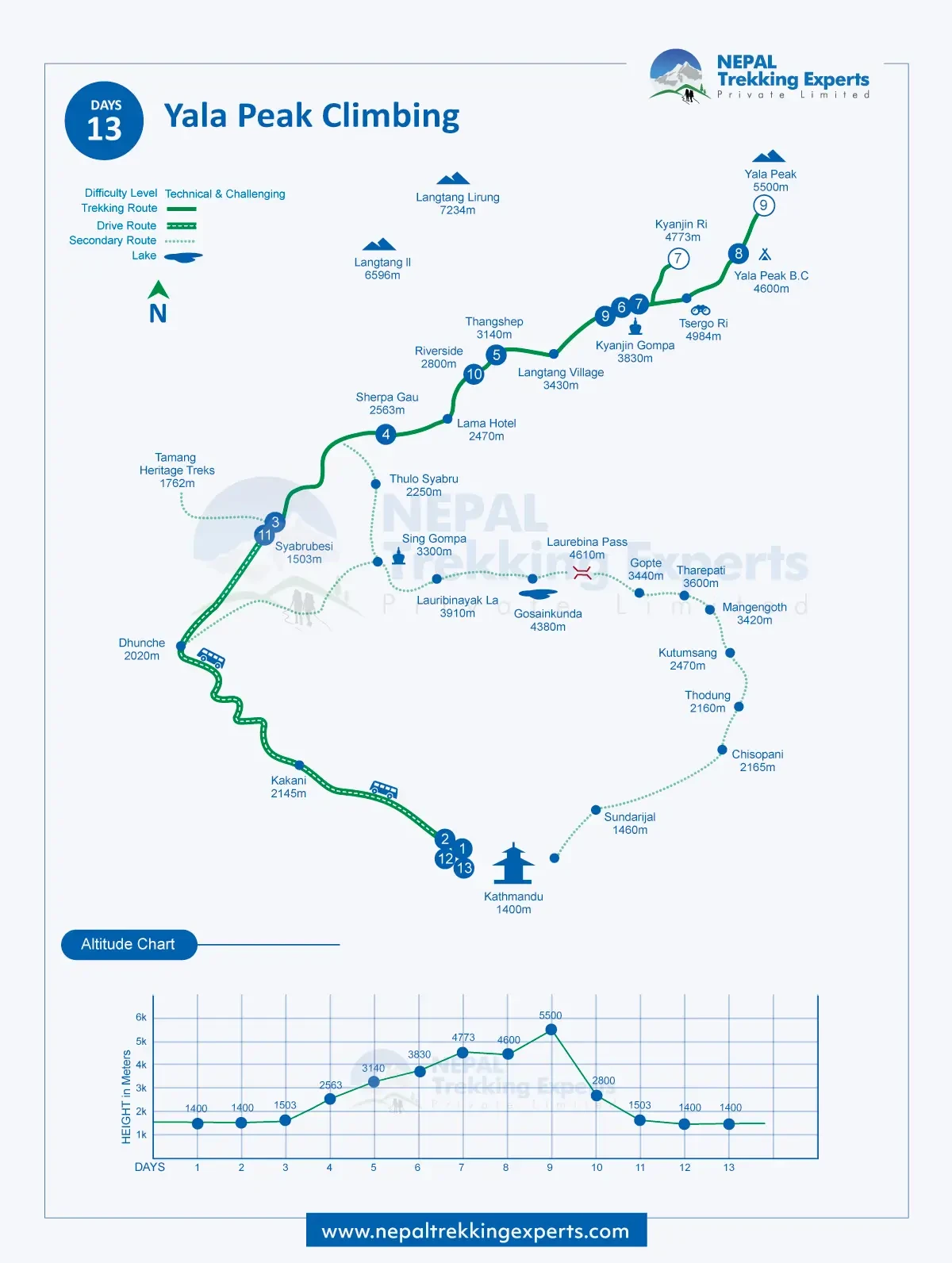
Yala Peak Climbing map
Dates & Availability
Start:SaturdaySep 05, 2026
End:ThursdaySep 17, 2026
PriceUS$1390
StatusGuaranteed
Start:SaturdaySep 12, 2026
End:ThursdaySep 24, 2026
PriceUS$1390
StatusGuaranteed
Start:SaturdaySep 19, 2026
End:ThursdayOct 01, 2026
PriceUS$1390
StatusGuaranteed
Start:SaturdaySep 26, 2026
End:ThursdayOct 08, 2026
PriceUS$1390
StatusGuaranteed

Note

We are putting some tailor made departure date but doesn`t mean you have to stick on it. Please feel free to choose any date convinient for you. 

Photos & Videos
FAQs for Yala Peak Climbing
  • Yes. Yala Peak Climbing is one of Nepal's most beginner-friendly trekking peaks, making it an excellent choice for first-time climbers with good physical fitness and proper acclimatization.

  • No previous mountaineering experience is required. With guidance from an experienced climbing Sherpa and basic instruction on using climbing equipment, most fit beginners can successfully summit Yala Peak.

  • Yala Peak is considered a moderately challenging peak. While it involves high-altitude trekking and a summit ascent to 5,732 meters, the climb requires minimal technical skills under normal conditions.

  • You should have a good level of physical fitness and be comfortable trekking 5 to 7 hours per day over several consecutive days at high altitude.

  • Most Yala Peak Climbing itineraries take 10 to 13 days, including the Langtang Valley Trek, acclimatization, summit attempt, and return to Kathmandu.

  • The highest point of the expedition is the Yala Peak summit at 5,732 meters above sea level.

  • Altitude sickness is possible above 3,000 meters, but proper acclimatization, staying hydrated, ascending gradually, eating well, and following your guide's advice greatly reduce the risk.

  • The summit offers spectacular views of Shishapangma, Langtang Lirung, Dorje Lakpa, Ganchenpo, Langshisha Ri, Naya Kanga, Ganesh Himal, and many other Himalayan peaks.

  • No. Yala Peak is a non-technical trekking peak under normal conditions, although crampons and basic climbing equipment may be needed depending on snow and ice conditions.

  • No. A licensed guide is required for trekking in the Langtang region, and climbing Yala Peak with an experienced guide or climbing Sherpa is strongly recommended for both safety and navigation.

  • Yes. Most technical climbing equipment, including crampons, harnesses, helmets, ice axes, and sleeping bags, can be rented from reputable trekking shops in Kathmandu.

  • Temperatures vary by season, but around Yala Peak Base Camp and on summit day, they can drop to -10°C to -15°C, and occasionally lower during winter or in strong winds.

You may also like
Related Packages
1Travelers' Reviews
  • TripAdvisor
    rating star

    Yala Peak climbing with Nepal Trekking Experts

    This was another unforgettable adventure with NTE, and once again they exceeded all expectations. From the very beginning, everything was professionally organized, making the entire trek smooth, enjoyable, and stress-free. The guides were experienced, supportive, and always prioritized our safety, which gave us great confidence throughout the journey.

    One of the highlights of the trek was successfully climbing Yala Peak. Reaching the summit was an incredible achievement, and being rewarded with the breathtaking sight of Shishapangma in all its glory made every step worthwhile. The panoramic mountain views were simply spectacular and created memories that will stay with us forever.

    The route through the beautiful Langtang Valley and the return via Gosaikunda made this trek even more special. We experienced a wonderful variety of landscapes, from lush forests and charming mountain villages to alpine meadows, pristine lakes, and snow-covered peaks. Every day offered something unique, and the scenery kept getting better as we progressed.

    What I appreciated most about this trek is that it strikes a perfect balance between challenge and enjoyment. It requires a reasonable level of effort, making it suitable for trekkers with a good level of fitness, while offering outstanding rewards in terms of scenery and overall experience. The itinerary was well-paced, allowing enough time for acclimatization, exploration, and enjoying the beauty of the Himalayas.

    I highly recommend this trek to anyone looking for an unforgettable Himalayan adventure. If you're searching for stunning mountain views, a rewarding trekking experience, and a reliable team to guide you every step of the way, this is an excellent choice. Thank you to the entire NTE team for another successful expedition—I look forward to trekking with you again in the future!

    A
    Andrzej WFeb 14, 2024Poland
Call us on WhatsApp+977 9841917136OrChat with us
Consult with a Travel Expert

Do you have any questions about the trips? Contact our travel experts in various countries.

Plan Your TripJoin Our Newsletter